info@brineweb.com
 +91 73599 99453





























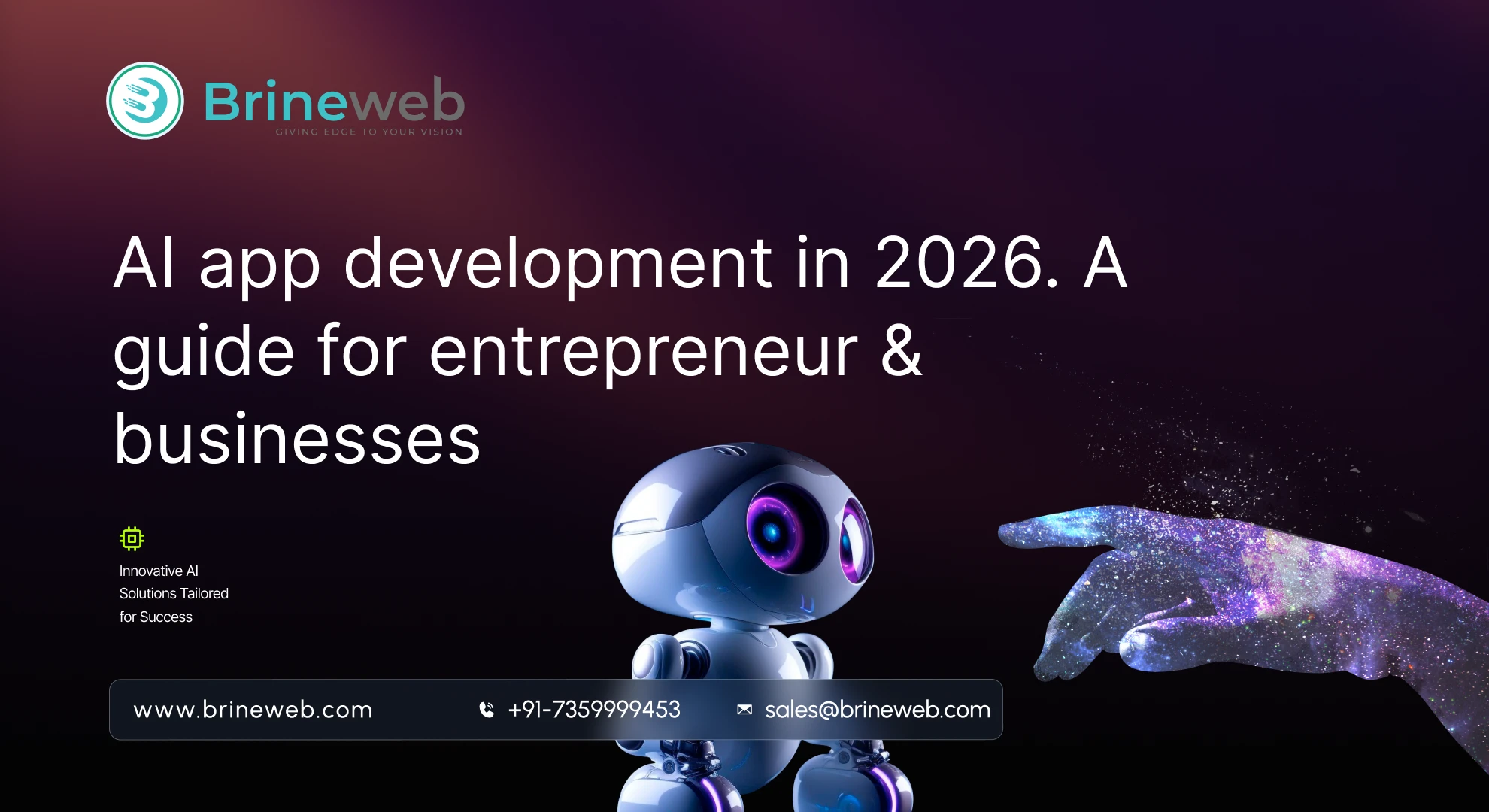
Artificial Intelligence is no longer a futuristic concept. It has become the backbone of modern business innovation. In 2026, AI is not just an upgrade it is a competitive mandate. Whether you're a startup founder, a service-based business, a SaaS company, a marketplace, or an enterprise exploring automation, AI apps will redefine how you operate, scale, and serve customers.
And here’s the good news:
The businesses that adopt AI now gain a long-term unfair advantage.
AI in 2026 is one of the biggest opportunities entrepreneurs will encounter in their lifetime similar to how mobile apps transformed business between 2010–2020.
This guide will walk you through everything:
✔ What AI app development really means in 2026
✔ What’s changed compared to previous years
✔ Major trends shaping the space
✔ How AI apps work
✔ Types of AI apps you can build
✔ Features modern AI apps must include
✔ Development steps & timeline
✔ Cost breakdown
✔ Mistakes to avoid
✔ Real business opportunities
✔ How to get started
Let’s begin.
1. Why 2026 Is a Breakthrough Year for AI Apps
AI between 2022–2025 grew rapidly but 2026 is the first year where AI becomes:
- Affordable
- Stable
- Enterprise-ready
- Multimodal (text + voice + image + video understanding)
- Capable of autonomous task execution
- Integrated into every business workflow
Several forces are shaping this acceleration:
1. LLMs are becoming more powerful AND efficient
Models like GPT-5, Gemini Ultra, Claude, and Llama are now capable of:
- Deep reasoning
- Multi-step decision-making
- Understanding business context
- Generating accurate, actionable output
2. AI agents have matured
Apps can now complete tasks autonomously:
- Analyze data
- Make decisions
- Execute actions
- Communicate
- Summarize
- Follow multi-step workflows
This makes 2026 the year of autonomous AI products.
3. Businesses demand automation
Hiring is expensive. Scaling a team is slow.
AI apps help companies:
- Reduce manual operations
- Improve productivity
- Deliver better customer experiences
- Reduce operational costs significantly
4. Data availability is at an all-time high
Businesses now have access to:
- Structured CRM data
- Unstructured support tickets
- Customer interactions
- Product usage behavior
- Industry datasets
AI feeds on data → 2026 enables smarter models.
5. AI regulation and compliance have stabilized
Clearer guidelines allow businesses to build responsibly without fear.
2. What AI App Development Really Means in 2026
AI app development isn’t just about integrating ChatGPT into your app.
It’s about creating intelligent systems that can:
- Learn
- Predict
- Reason
- Act
- Personalize
- Optimize
An AI app in 2026 can do things human employees used to do faster, cheaper, and at scale.
There are 3 levels of AI apps:
Level 1 : AI-Enabled Apps
These apps use AI features but aren’t fully AI-driven.
Examples:
- Smart search
- Image detection
- Auto-generated summaries
- Personalized recommendations
Level 2 : AI-Assisted Apps
AI supports users by performing tasks.
Examples:
- AI writing assistants
- AI scheduling tools
- AI chatbots
- AI insights dashboards
Level 3 : AI Autonomous Apps (2026’s big trend)
Apps that perform entire workflows without human involvement.
Examples:
- AI customer support agents
- AI sales closers
- AI hiring screeners
- AI operations managers
- AI product researchers
3. Key AI Trends Shaping 2026
To build a competitive AI app, you need to understand where the world is moving.
Here are the top AI trends every entrepreneur should know:
Trend 1: Autonomous AI Agents
Agents can:
- Interact with tools
- Make decisions
- Take actions
- Complete complex tasks
- Run workflows end-to-end
This will disrupt every industry.
Trend 2: Multimodal AI
AI apps now understand:
- Text
- Voice
- Images
- Video
- Charts
- Documents
This unlocks a new era of user experience.
Trend 3: Personalized AI Assistants for Every Business
Every company will have:
- An AI support agent
- An AI sales rep
- An AI operations assistant
- An AI HR coordinator
Trend 4: AI + IoT + Edge Computing
AI apps will run directly:
- On devices
- On cameras
- On sensors
- Offline
Perfect for industries like logistics, security, and agriculture.
Trend 5: Voice-First Interfaces
Users will interact with apps the way they speak to humans.
Trend 6: Vertical-Specific AI Apps
AI solutions tailored for:
- Healthcare
- Finance
- Hospitality
- Education
- Retail
- Logistics
- Agriculture
General AI is powerful.
Industry-specific AI is unstoppable.
4. How AI Apps Work (Simple Breakdown)
AI apps are powered by several layers:
1. AI Model
- LLMs (GPT-5, LLaMa, Claude)
- ML models
- Computer Vision models
2. Vector Database
Used for RAG (Retrieval-Augmented Generation).
Stores:
- Documents
- Business data
- Internal knowledge
- Product details
3. Backend APIs
The logic layer that connects:
- Frontend app
- AI model
- Tools
- Actions
4. User Interface
Conversational UI → forms + chat + voice input.
5. Feedback Loop
Continuous learning → improved accuracy.
5. Types of AI Apps Entrepreneurs Can Build in 2026
This section is gold for anyone planning a startup or new business unit.
A. Productivity & Business Operations
- AI scheduling apps
- AI project managers
- AI meeting summarizers
- AI email handlers
- AI negotiation assistants
B. Industry-Specific AI Apps
1. Healthcare
- AI diagnosis assistant
- Medical imaging analysis
- Patient symptom checker
2. Fintech
- Fraud detection
- Credit scoring
- Portfolio advisory
3. Education
- Personalized AI tutors
- Homework grading AI
4. Retail
- AI price optimization
- AI shopper assistants
5. Logistics
- Route optimization
- Predictive delivery apps
C. Consumer AI Apps
- AI fitness coach
- AI mental wellness bot
- AI travel planner
- AI fashion stylist
D. Enterprise AI Apps
- HR AI
- CRM intelligence
- AI procurement assistant
- Compliance auditing AI
6. Essential Features for an AI App in 2026
To succeed, AI apps must include:
✔ Natural language interface
✔ Multimodal input
✔ Real-time personalization
✔ Autonomous task execution
✔ AI safety layer
✔ Human override options
✔ Detailed analytics
✔ Knowledge database
✔ API integrations
✔ Secure data processing
7. Step-by-Step Process to Build an AI App (2026 Edition)
This is how BrineWeb or any modern AI-focused company should approach AI development.
Step 1: Identify the Business Opportunity
Ask:
- What task wastes the most time?
- What process is expensive?
- What decision requires intelligence?
Step 2: Choose the AI Approach
Options:
- LLM-only
- LLM + RAG
- Fine-tuned models
- Custom ML models
- Computer vision
- Hybrid approach
Step 3: UX & Interaction Design
2026 AI apps rely heavily on:
- Conversational design
- Prompt architecture
- Workflow mapping
Step 4: Build AI Infrastructure
Includes:
- Vector DB
- Model selection
- API integration
- Knowledge base
Step 5: Develop User Interface
Frontend for:
- Web
- iOS
- Android
Step 6: Integrate Tools & Actions
So the app can DO things, not just talk.
Step 7: Testing (Very Different for AI)
Test for:
- Accuracy
- Bias
- Hallucinations
- Performance
- Safety
Step 8: Deploy & Monitor
AI apps evolve continuously.
8. Cost to Build an AI App in 2026
The cost to build an AI app in 2026 varies widely depending on complexity, features, and how much custom AI development is required. On average, UI/UX design can range from $1,500 to $5,000, while AI model integration typically costs between $5,000 and $40,000. If the project requires custom machine learning models, this can add another $10,000 to $70,000. Backend development usually falls between $4,000 and $25,000, with frontend development costing around $5,000 to $30,000. Building advanced AI agents may add $10,000 to $50,000, and testing and QA generally range from $1,000 to $5,000. Altogether, the total investment for developing an AI app in 2026 realistically falls between $12,000 and $150,000+, depending on the level of sophistication and custom AI capabilities required.
9. Common Mistakes Founders Make (Avoid These!)
- Building AI without real data
- Ignoring model drift
- No safety guardrails
- Overcomplicated UI
- Wrong model selection
- Poor prompt engineering
- Not thinking about scaling
10. Real AI Opportunities for Entrepreneurs in 2026
Here are high-demand ideas you can build:
- AI customer support agent
- AI sales closer
- AI hiring screener
- AI real estate valuation engine
- AI legal document analyzer
- AI market research analyst
- AI accounting & GST automation
These industries are rapidly adopting AI and have massive demand.
11. Should You Build or Buy an AI Solution?
Build if:
- You need custom workflows
- You want a long-term competitive advantage
- You handle sensitive industry data
- You want to own your IP
Buy if:
- You’re testing an idea
- You need quick output
- You want to validate demand
12. Final Thoughts: Why 2026 Is the Best Time to Build an AI App
AI will not replace businesses.
But businesses that use AI will replace businesses that don’t.
2026 presents a golden window AI tools are powerful, affordable, and accessible. Entrepreneurs who leverage this window will scale faster, reduce costs, and unlock new revenue models.
If you’re planning to build an AI app, this is the right time to start.