info@brineweb.com
 +91 73599 99453






























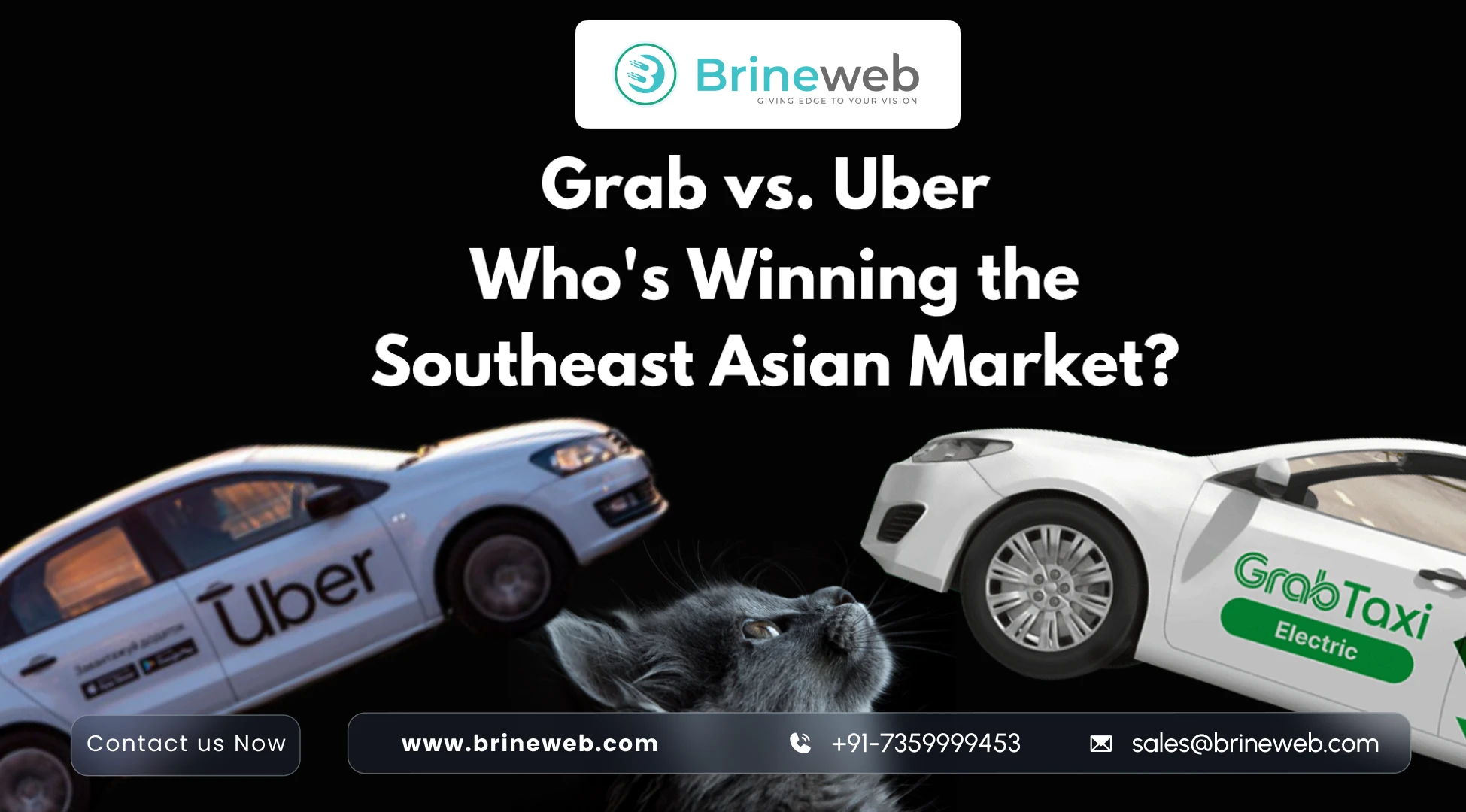
In 2018, Uber sold its entire Southeast Asian operation to Grab for a 27.5% equity stake. Uber stopped competing and became a shareholder instead. Seven years later it still holds roughly 14% of Grab that's how decisively the fight ended.
Why Uber lost, how Grab built its dominance since, and where the real competitive pressure is coming from now says more about what it takes to win a mobility market than the headline numbers do.
The Numbers in 2026
Grab holds an estimated 70% of the Southeast Asian mobility market and 55% of the food delivery market. In some countries it previously held over 90% ride-hailing share.
Southeast Asia's internet economy excluding digital finance is projected to reach $555 billion in GMV by 2030, up from $305.5 billion in 2025 at a 12.6% CAGR. Transport and mobility GMV is forecast to nearly double from $11.5 billion in 2025 to $22.5 billion by 2030. Food delivery GMV grows from $23 billion to $36 billion in the same period.
Grab operates across eight countries: Singapore, Malaysia, Indonesia, Thailand, the Philippines, Vietnam, Cambodia, and Myanmar. It serves 35 million+ monthly active users with $15 billion+ in gross merchandise value.
Uber, by comparison, earns approximately 15 times Grab's revenue globally but has 3.8 times the monthly transacting users. That means Uber earns roughly 4 times more per user than Grab. The difference reflects market maturity: Southeast Asia is a developing region where per-ride fares are lower, but the user base is young, growing, and has decades of increasing purchasing power ahead.
Why Uber Left Southeast Asia
Uber entered Southeast Asia in 2013 with the same playbook it used everywhere else: throw money at driver incentives, subsidise rides to capture market share, and outspend competitors into irrelevance.
It worked in North America against Lyft. It worked in Europe against local challengers. It did not work against Grab in Southeast Asia.
Grab had three structural advantages Uber could not overcome regardless of spend.
Local knowledge. Grab was founded in Malaysia by Anthony Tan, who understood local payment preferences, traffic conditions, cultural nuances, and regulatory relationships at a level Uber's US-based management never matched. Grab accepted cash payments from day one because it understood that the majority of Southeast Asian consumers were unbanked or underbanked. Uber insisted on cards-only for far too long in markets where that excluded most of its potential users.
Government relationships. Grab worked with regulators across each market rather than against them. In several countries where Uber faced regulatory pushback and outright bans, Grab operated smoothly. Local regulatory compliance is not a competitive advantage most founders think about. In Southeast Asia it was decisive.
First mover density in the right markets. Grab entered motorcycle taxis (ojek in Indonesia, motobike in Vietnam) which are the dominant urban transport mode across the region. Uber focused on cars. A car in Bangkok or Jakarta rush hour is not a competitive transport mode against a motorcycle. Grab's willingness to serve the actual mobility need rather than the familiar Western one gave it supply density that cars alone could never match.
By 2017, Uber's strategy had quietly shifted from "win Southeast Asia" to "don't lose too much money while being present." That's a losing posture in a winner-takes-most market, and Grab's 2018 acquisition of Uber's operations confirmed it.
What Grab Built After Uber Left
Uber's exit gave Grab temporary market dominance. What Grab did with that dominance is what separates it from a regional taxi app and makes it worth studying.
Rather than just running rides, Grab built a super-app. Rides became GrabCar. Food delivery became GrabFood. Grocery delivery became GrabMart. Payments became GrabPay. Lending became GrabCredit. Insurance, hotel bookings, movie tickets, and telemedicine all came later.
The super-app strategy creates a compounding retention effect. A user who books rides, orders food, pays bills, and takes out a small loan through GrabPay has switching costs that a ride-only user does not. Every additional service added to the platform increases the cost of leaving it.
GrabPay is particularly important. With 80% of the Southeast Asian population either unbanked or underbanked in most markets Grab operates in, a digital wallet embedded inside the ride app was not just a payment feature. It was a financial inclusion product serving hundreds of millions of people who had no equivalent from a traditional bank. The data GrabPay generates on spending habits is now a significant advertising and financial services asset.
For a complete breakdown of how Grab's business model works across all its verticals and how it generates revenue from each one, our Grab business model guide covers the full picture.
Gojek: The Competition That Matters Now
Uber is not Grab's primary competitive threat in 2026. Gojek is.
Gojek, through its parent GoTo Group, is Grab's most serious challenger. It dominates Indonesia, Southeast Asia's largest market with 270 million people. Grab and Gojek together hold over 91% of Indonesian ride-hailing, which is why Grab's rumoured acquisition of GoTo's on-demand services has attracted significant antitrust scrutiny from Indonesia's competition regulator.
If that deal happens, Grab would effectively monopolise the region's largest market. If it doesn't, the two platforms continue competing for Indonesia's enormous and growing ride-hailing and delivery market.
Gojek built its platform differently from Grab. Where Grab expanded geographically across eight countries, Gojek went deep in Indonesia first and built fintech (GoPay) as its highest-margin vertical. The contrast is instructive: geographic breadth versus market depth, both with super-app ambitions, but executed through opposite strategic priorities.
Our Gojek business model guide covers how GoTo achieved its first full-year adjusted EBITDA profitability in 2024 and where it's heading in 2026.
inDrive: The Unexpected Challenger
The competitive threat that most analysts missed is inDrive.
In the Philippines, previously a market where Grab held approximately 90% share, inDrive entered with its reverse-bidding model at 10% commission versus the industry norm of 20 to 25%. Rides grew approximately 8 times and passengers approximately 7 times in 2025. Grab's share in the Philippines is now estimated at 80 to 85% and falling.
inDrive's playbook is simple and brutally effective. Lower commission attracts more drivers. More drivers means faster pickups and lower fares for passengers. Lower fares combined with transparent pricing builds trust in markets where algorithmic surge pricing has created genuine resentment.
Grab has responded with vouchers and incentives in the Philippines, which converts a previously profitable market into one requiring ongoing subsidy spend to defend. That's a significant strategic setback from a unit economics perspective.
The same pressure is appearing in Vietnam, where local platforms are gaining ground. The lesson for every operator in the region is that Grab's 70% regional share is not uniformly distributed. In specific markets and specific cities, the door is still genuinely open for a focused challenger.
Our inDriver business model guide explains exactly how its bidding model works and why it consistently wins in price-sensitive markets.
Grab vs. Uber: The Financial Comparison
They're not really competing anymore, but comparing their financial profiles reveals what the Southeast Asian exit cost Uber and what it gave Grab.
Revenue. Uber earns approximately 15 times Grab's revenue. Grab's 2024 revenue came in at approximately $2.8 billion, while Uber's 2025 revenue was $43.98 billion. The scale difference is enormous.
Revenue per user. Uber earns approximately 4 times more per monthly transacting user than Grab. This reflects Southeast Asia's lower average fares rather than any quality difference. As the region's middle class grows and per-capita incomes rise, Grab's per-user revenue will increase without any strategic effort on Grab's part.
Profitability timing. Grab reached its first profitable quarter in 2024 and projects full-year profitability in 2025. Uber achieved its first full-year GAAP net income in 2024. Both are now profitable. The decade-long "growth at any cost" phase is over for both companies.
Valuation. Uber's market cap sits at approximately $189 billion. Grab's valuation is significantly lower, reflecting its smaller scale and developing market context. But Grab's growth rate in its home region, and the long runway ahead as Southeast Asian incomes rise, make it one of the most interesting emerging market platform investments available.
Country by Country: Who Wins Where
Singapore. Grab's home market. Dominant across rides, food, and financial services. Gojek operates here as a challenger. ComfortDelGro competes in taxis.
Malaysia. Grab's founding market. Strong across all verticals. Yango and newer challengers have small footholds. Starting a taxi business here means competing primarily with Grab in a market it knows better than any competitor.
Indonesia. The most contested market. Grab and Gojek split dominance. Combined share exceeds 91%. The potential Grab-GoTo deal would reshape this entirely.
Thailand. Grab leads with strong market share. Bolt entered with EV ride hailing in May 2026. inDrive is expanding. Tourism-driven demand in Bangkok, Phuket, and Chiang Mai creates premium segments.
Philippines. Grab's share declining from ~90% to ~80-85% as inDrive grows aggressively. The most interesting active competitive battle in the region right now.
Our comprehensive Philippines taxi app development guide explains everything you need to know, from business registration and payment integration to local market opportunities, helping you launch with confidence.
Vietnam. Local platforms gaining ground. Grab holds leadership but faces more competitive pressure than in Malaysia or Singapore.
What This Means for Founders Entering Southeast Asia
The Southeast Asian mobility market is large, growing, and not monolithic. Grab's regional dominance masks genuine heterogeneity across countries and within cities.
The practical lessons are direct.
Pick a specific country and go deep. Grab's dominance is strongest in Singapore and Malaysia. It's more vulnerable in the Philippines, Vietnam, and specific Indonesian cities outside Jakarta. Enter where the incumbent's density is thinnest.
Commission rate is a market entry weapon. inDrive's 10% versus Grab's 20 to 25% is not just a pricing tactic. It's a supply-side acquisition strategy that attracts drivers, builds volume, and forces the incumbent to spend on defence.
The super-app is a retention mechanism. Every service you add on top of rides raises the cost of switching. Even a simple GrabPay-style wallet, if it holds value that users accumulate, creates stickiness that a ride-only competitor cannot break with price alone.
Local regulatory relationships are not optional. Uber's regulatory friction in multiple Southeast Asian markets was a meaningful factor in its decision to exit. Grab's willingness to work with local authorities, rather than around them, was a structural competitive advantage. Build regulatory compliance into your operations from day one.
Planning to launch a ride-hailing platform in Indonesia? Before building your app, it's important to understand the country's regulations, licensing requirements, competitive landscape, and user expectations. Our comprehensive Indonesia taxi app development guide explains everything you need to know, from business registration and payment integration to local market opportunities, helping you launch with confidence.
Malaysia offers a growing opportunity for ride-hailing startups, but success depends on complying with local transport regulations and building features that match customer expectations. Our Malaysia taxi app development guide covers licensing, legal requirements, market trends, pricing strategies, and the key features needed to compete with established players.
Thailand's urban mobility market continues to expand, creating opportunities for innovative taxi and ride-hailing businesses. Our detailed Thailand taxi app development guide walks you through the regulatory framework, driver requirements, payment options, competition, and localization strategies so you can launch your platform successfully.
Ready to Enter the Market?
Southeast Asia's transport and mobility GMV is heading from $11.5 billion in 2025 to $22.5 billion by 2030. Grab dominates but does not own every geography, every niche, or every price point.
The founders who win in this market are the ones who pick the right gap, move fast with the right technology, and build supply density in one area before expanding.
Brine Go by Brineweb gives you a white-labeled ride-hailing platform ready to configure for any Southeast Asian market, with local payment integration, language support, and driver compliance management.
Get a free quote from Brineweb and find out what it costs to launch.