info@brineweb.com
 +91 73599 99453




























Most people know Rover as the app you use when you need someone to watch your dog over the weekend. That description is accurate but thin.
Rover is the world's largest online marketplace for pet care. It connects pet owners with independent sitters and walkers offering overnight boarding, in-home pet sitting, doggy daycare, dog walking, and drop-in visits. From its inception through September 2023, Rover booked over 93 million services and served more than 4 million pet owners across North America and Europe.
In February 2024, Blackstone completed its acquisition of Rover in an all-cash transaction valued at approximately $2.3 billion. That price tag tells you everything about how seriously the market takes the pet care economy.
This is a complete breakdown of how Rover works, how it makes money, how it grew, and what any founder building an on-demand service marketplace can learn from it.
What Problem Did Rover Solve?
Before Rover, finding reliable pet care meant calling friends, posting on Craigslist, or paying expensive boarding facilities that felt impersonal and stressful for animals. The problem was not a lack of pet lovers willing to help. It was trust, discovery, and convenience.
Rover was created to provide an alternative to relying on friends, family, neighbors, and boarding facilities for pet care when traveling away from home.
That is a deceptively simple insight. Millions of pet owners travel regularly. Millions of pet lovers want flexible income. Nobody had built a trusted, tech-enabled marketplace to connect them at scale. Rover did.
The timing mattered too. The U.S. pet care market is estimated to be worth over $100 billion, and the global pet care market is projected to reach $493 billion by 2030. Rover entered a market with massive existing demand and almost no digital infrastructure serving it.
How Rover Works: The Operational Flow
Rover runs an asset-light, two-sided marketplace. It employs no pet sitters directly and owns no facilities. It connects supply with demand, manages trust and payments, and takes a cut of every transaction.
From the pet owner's side, the experience is straightforward. You open the Rover app or website, enter your location and the service you need, browse caregiver profiles with photos, bios, rates, and verified reviews, and book and pay securely through the platform. Once the service begins, you receive real-time GPS tracking for walks, in-app photo and message updates from your sitter, and end-of-service confirmation. You rate the sitter after each booking, and most owners rebook with the same person regularly.
From the sitter or walker's side, you create a profile showcasing your services, experience, availability, and pricing. You pass a background check before your profile goes live. You accept or decline booking requests through the app, communicate with pet owners in-app, and receive payouts directly to your bank account. Rover's platform hosts over 660,000 pet care providers.
The platform in the middle handles matching, payments, dispute resolution, insurance, and customer support. Rover ensures trust and safety by providing insurance coverage for pet sitters and walkers, background checks, and secure payments. This infrastructure is what makes strangers trust each other enough to hand over their pets.
Rover's Services: What It Actually Offers
Rover covers every scenario a pet owner might face.
Overnight boarding is the highest-revenue service. The sitter takes your pet to their home for one or more nights. This is typically the most expensive service and accounts for the largest share of Rover's gross booking value.
In-home pet sitting means the sitter comes to your home and stays overnight, keeping your pet in their own environment. It carries a premium price.
Dog walking is a recurring service, often booked daily or weekly. It drives high booking frequency and repeat revenue.
Doggy daycare provides daytime supervision at the sitter's home while the owner works.
Drop-in visits are short 30-minute check-ins at the owner's home for feeding, playtime, and a quick walk.
A majority of Rover's revenue comes from its marketplace connecting pet owners with sitters for overnight stays. But the breadth of services ensures Rover captures recurring revenue from the same customers across multiple use cases rather than just episodic travel bookings.
Rover's Business Model: The Two-Sided Marketplace
Rover is structurally a marketplace business. Its value comes not from any product it manufactures but from the network it manages the more quality sitters it has, the more owners it attracts the more owners it attracts, the more sitters want to join.
This network effect creates a compounding advantage over time. A new competitor does not just need to build better features. They need to overcome Rover's density of verified sitters and the trust that thousands of reviews have built.
The model is also asset-light by design. Rover does not pay sitters as employees, does not own facilities, and does not operate vehicles. Every service delivery cost sits with independent contractors. Rover's cost structure is primarily technology, marketing, support, and trust infrastructure, which scales more efficiently than a fleet-based or facility-based model ever could.
Rover's Revenue Model: How It Makes Money
Rover charges both sides of the marketplace. This dual-fee structure is the core of its financial model.
1. Service Fees from Pet Owners
Every booking a pet owner makes through Rover includes a platform service fee on top of the sitter's listed rate. Pet parents pay a 5 to 7 percent service fee of the entire booking. This fee covers platform access, customer support, and the Rover Guarantee.
2. Commission from Service Providers
Sitters and walkers pay a significantly larger fee on every booking they complete. Pet care providers pay a 15 to 20 percent service fee of the total booking price, depending on whether their account was created on or before March 1, 2016. Combined, Rover obtains a combined service fee of 20 to 27 percent from every booking.
This dual-sided fee structure means Rover earns from both parties on every transaction without directly providing the service itself. It is a highly efficient revenue model at scale.
Rover's commission-per-booking approach mirrors how major on-demand platforms such as Grab and Gojek monetize marketplace transactions — a pattern also clearly visible in how UberEats structures its revenue through restaurant commissions and layered service fees.
3. Background Check Fees
Rover generates revenue by charging pet care providers to undergo background checks before being approved for work on the platform. Every sitter who joins pays for this verification. With over 660,000 providers on the platform, this is a meaningful one-time revenue stream from each new supply-side member.
4. Premium Listings and Visibility
Sitters and walkers can pay to appear higher in search results, similar to promoted listings on other marketplaces. This gives providers who invest in visibility more bookings while generating incremental advertising-style revenue for Rover.
5. Subscription Plans
Pet owners can subscribe to monthly plans with discounted booking fees and priority customer support, improving retention and creating predictable recurring revenue on top of the transaction-based model.
6. Affiliate Revenue
Every time a Rover user reads one of their blog posts, clicks a link, and makes a purchase from a sponsored affiliate, Rover earns money. Rover's content operation attracts millions of pet owners searching for care advice, and affiliate partnerships with pet product companies monetize that traffic without adding operational complexity.
Rover's Financial Growth
The numbers tell a clear growth story.
In 2021, Rover generated $100 million in revenue. In 2022, it grew to $170 million. In 2023, Rover achieved estimated annual revenue of approximately $230 million, representing a 36% year-over-year increase as of Q3 2023. The projected revenue for calendar year 2024 was $278 million, with an adjusted EBITDA of $75 million.
Rover surpassed a billion-dollar run rate in Q3 of the year prior to its acquisition, as measured by gross sales. Revenue was up 30% year-over-year to $66.2 million in that quarter, with net income of $10.5 million.
That trajectory, from $100 million to a $278 million run rate in three years while becoming EBITDA positive, is what made Rover attractive enough for Blackstone to pay a 61% premium over its 90-day trading average.
The Blackstone Acquisition: Why It Happened
The transaction was announced on November 29, 2023 and approved by Rover stockholders at a special meeting on February 22, 2024.
Why would Blackstone pay $2.3 billion for a pet care marketplace? Three reasons.
First, market size. Bloomberg Intelligence estimated the pet industry market size will reach $500 billion by 2030, up from $320 billion in 2023. Rover leads the digital slice of that market with no close second.
Second, competitive positioning. Rover's closest competitor is Wag!, a significantly less-scaled company trading below a $100 million market value. Rover's lead in provider density and brand trust is not easy to replicate.
Third, growth runway. Blackstone's investment aims to help Rover accelerate investment priorities, expand its global footprint, and fuel expansion initiatives. Going private removes the short-term pressure of quarterly earnings and gives the company room to invest in international growth without the market penalizing it.
Rover's Growth Strategy: What Drove the Expansion
Rover did not grow to a $2.3 billion acquisition by accident. Several deliberate strategic choices compounded over time.
Trust as the core product. Background checks, verified reviews, GPS tracking, photo updates, and insurance are all trust mechanisms. Rover's commitment to safety and quality has been crucial in overcoming the biggest hurdle in the pet care industry convincing pet owners to entrust their beloved animals to strangers. Every feature that reduces anxiety about a stranger caring for your pet directly increases conversion and retention.
Geographic depth before breadth. Rover built dense, high-quality supply in existing markets before expanding to new ones. Rover now provides services in 10 countries the U.S., Canada, United Kingdom, France, Spain, Italy, Germany, Sweden, Netherlands, and Norway.
Strategic acquisitions to accelerate market entry. Rather than building from scratch in every new market, Rover acquired existing local platforms. The acquisitions of Cat in a Flat in October 2024 and Gudog in April 2025 demonstrate a strategy to integrate new platforms and expand technical capabilities. In July 2025, Rover also announced a binding agreement to acquire Mad Paws, Australia's leading pet care marketplace.
Content marketing that owns organic search. Rover's blog, The Dog People, ranks for thousands of pet care queries and drives organic traffic directly into the booking funnel. This is affiliate-monetized content that simultaneously builds trust and reduces paid acquisition costs.
Technology investment in matching. AI-powered matching algorithms use machine learning to better match pet owners with the most compatible sitters and walkers, improving satisfaction and reducing booking time. Better matches mean better reviews, lower churn, and stronger network effects.
Challenges Rover Faces
No business model analysis is complete without the honest part.
Regulatory complexity. Pet care services are subject to local licensing and zoning laws that vary by market. What is legal in one city may require permits in another. Scaling globally multiplies this complexity significantly.
Supply quality control. With over 660,000 sitters on the platform, maintaining consistent quality is hard. A single bad experience shared on social media can damage trust disproportionately. This is why Rover invests heavily in reviews, dispute resolution, and insurance rather than just acquisition.
Gig economy pressures. As governments in multiple markets tighten labor classification laws for gig workers, platforms like Rover face potential regulatory changes that could affect their cost structure. This is the same risk Uber, Lyft, and DoorDash navigate continuously.
Economic sensitivity. Pet care is a discretionary service. During economic downturns, pet owners may reduce spending on boarding and walking before cutting other expenses. Data from 2024 indicated a decrease in pet care spending during economic uncertainty.
What Founders Building On-Demand Services Can Take From Rover
Rover's story contains several lessons that apply well beyond pet care.
Trust infrastructure is not optional. Background checks, insurance, reviews, and real-time visibility into service delivery are not features you add later. They are the reason people use your platform instead of handling it informally. Build trust mechanisms from day one.
Own both sides of the marketplace revenue. Rover charges pet owners and sitters. Both fees are justified by the value Rover delivers to each side. If you build a marketplace and only charge one side, you are leaving half your revenue on the table.
Recurring services beat one-time bookings. Dog walking drives weekly repeat bookings from the same customers. That frequency builds habit, reduces churn, and lowers cost-per-booking over time. When designing your service mix, favor services that create recurring demand over episodic ones.
Content builds trust and traffic simultaneously. Rover's blog attracts millions of pet owners through organic search and converts them into platform users. For any on-demand marketplace, a content strategy around the problems your customers search for is one of the highest-return investments you can make.
Acquisitions are faster than organic expansion. Rover entered Australia, Europe, and new categories through targeted acquisitions rather than rebuilding local supply from zero. Once you have proven your model, buying an established local player is often faster and cheaper than growing organically in an unfamiliar market.
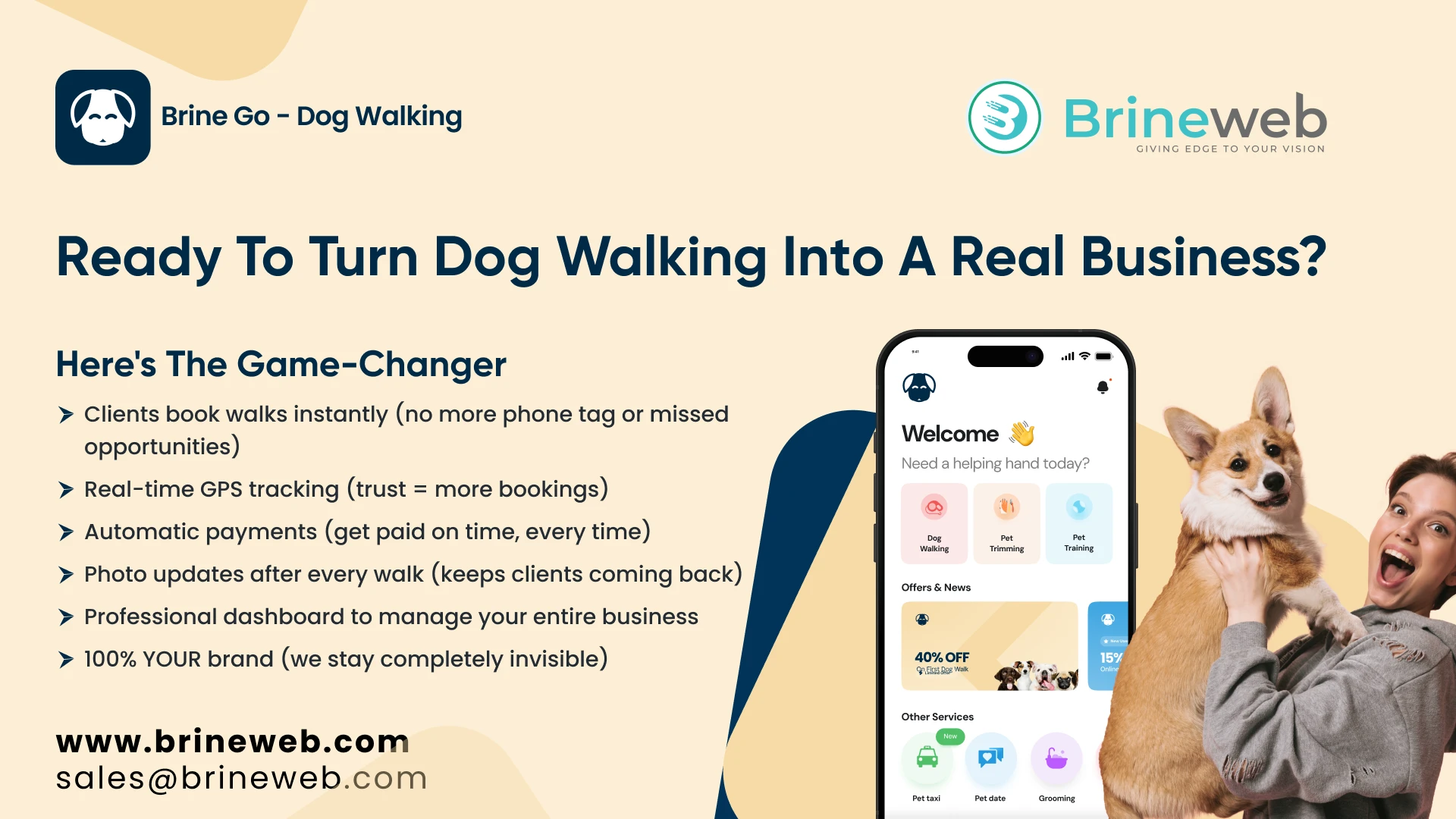
If you want to build a dog walking app, a pet care marketplace, or any on-demand service platform, Brineweb's dog walking app gives you a production-ready, white-labeled foundation covering the core infrastructure provider verification, booking, GPS tracking, in-app payments, and admin management. You bring the market and the brand. The technology is already built.
For broader on-demand service platforms across multiple categories, Brineweb's on-demand service app solutions let you launch a multi-service marketplace without building everything from scratch.
The Future of Rover
Under Blackstone's ownership, Rover is investing in international expansion through acquisitions, deeper AI-powered matching, virtual pet training through GoodPup, and additional service categories. The company's trajectory points toward becoming the default global platform for all forms of professional pet care, not just sitting and walking.
The pet industry was a laggard for a decade in terms of tech adoption, and a large chunk of it is still highly fragmented, as Rover's own CEO noted. That fragmentation is an opportunity for any founder willing to go deep in a specific niche or geography that Rover has not yet reached with sufficient supply density.
Final Thought
Rover is not just an app for dog lovers. It is a trust marketplace that solved a real daily problem for millions of pet owners and built a $2.3 billion business by doing it better than anyone else.
The core model is replicable. Not by copying Rover in markets it already dominates, but by applying the same principles, trusted supply, seamless booking, recurring services, and strong content, to adjacent service categories or underserved geographies.
The pet care market is still growing. The on-demand service economy is still expanding. The founders who study how Rover built trust at scale and apply those lessons to their own market will be the ones who build the next category leaders.
Ready to build your own on-demand service marketplace? Talk to the Brineweb team and get a free quote for a custom or white-labeled app built for your market and service category.