info@brineweb.com
 +91 73599 99453































How does UberEats make money in one sentence?
UberEats earns through restaurant commissions of 15 to 30% per order, customer delivery and service fees, Uber One subscription revenue, in-app advertising from sponsored restaurant listings, food, grocery and pharmacy delivery commissions applied across an expanding range of non-food verticals.
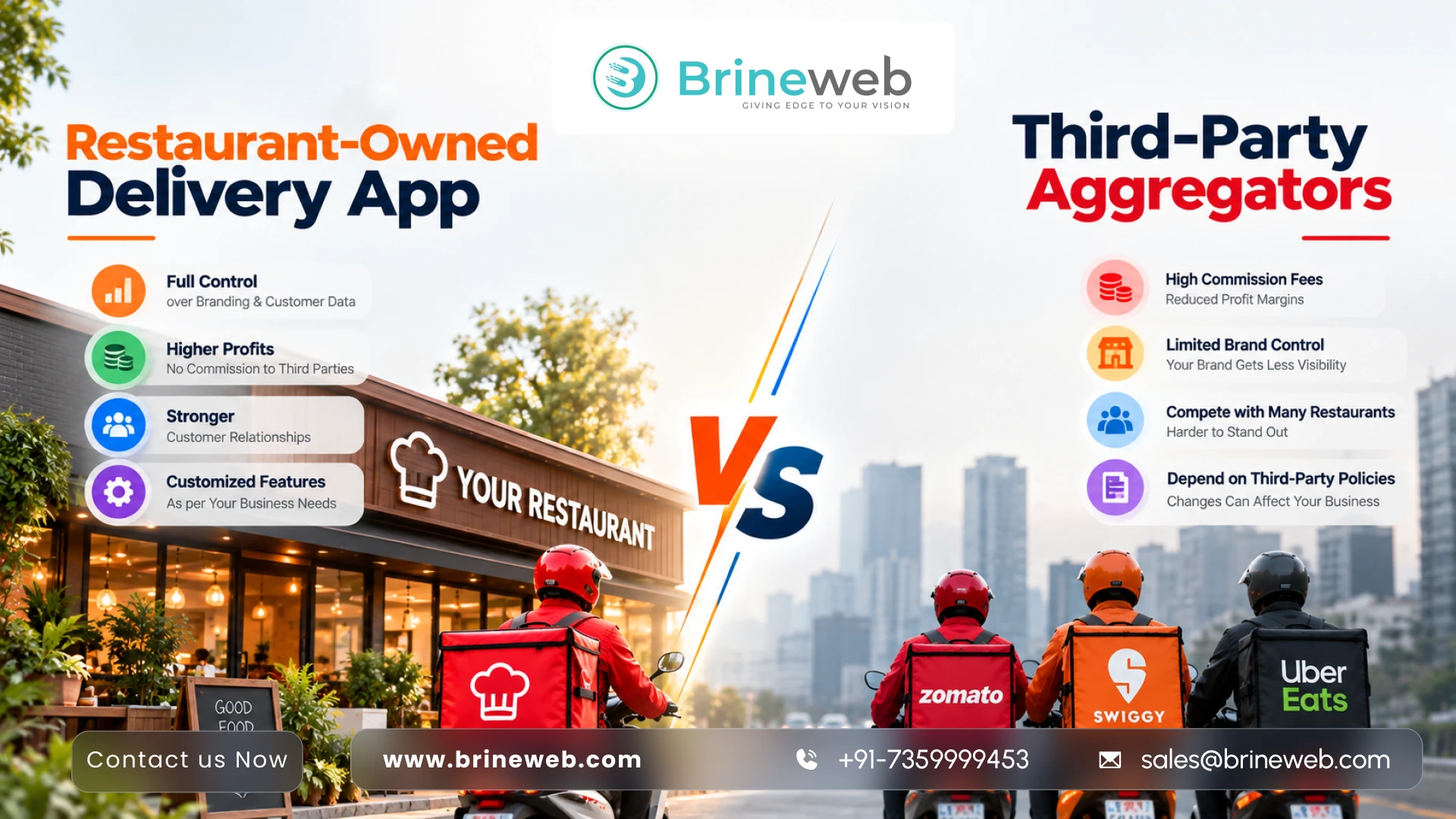
For founders looking to enter this space, investing in a scalable food delivery app development solution is the first step toward building a profitable platform like Uber Eats.
From a Los Angeles Experiment to a $15 Billion Business
UberEats launched in 2014 as a small test called UberFRESH in Los Angeles. The idea was simple use Uber's existing driver network and GPS infrastructure to move food instead of people. It did not require a new driver fleet. It did not require new payment infrastructure. It was a second job for assets Uber had already built.
That initial simplicity is deceptive. What followed was one of the fastest revenue growth trajectories in the history of consumer technology.
UberEats generated $0.6 billion in revenue in 2017. By 2024 that number reached $13.7 billion. In Q4 2025, the Uber delivery segment posted gross bookings of $54.1 billion for the full year 2025, with adjusted EBITDA of $2.5 billion in Q4 alone, up 35% year on year. Free cash flow for the full year 2025 hit $10 billion across the combined Uber platform.
The delivery segment has moved from a cash-burning growth bet to a mature profit engine in under a decade. Understanding exactly how that happened is the most useful business model study available for any founder entering the food delivery or on-demand delivery space today.
What Is UberEats? The Three-Sided Marketplace
UberEats is a three-sided marketplace. It connects three groups simultaneously through a single platform customers who want food delivered, restaurants that prepare food, and delivery partners who move it. The platform sits at the centre, handling matching, payments, routing, trust infrastructure, and all the technology that makes the experience seamless for each party.
Each side has a distinct value proposition.
For customers: access to hundreds of restaurants in their city from a single app, real-time GPS tracking of their order from preparation to delivery, upfront pricing with no surprises, and the convenience of paying digitally without carrying cash.
For restaurants: access to UberEats' 100 million monthly active users without building delivery infrastructure themselves. The platform handles driver recruitment, logistics, payment processing, and customer acquisition. Restaurants trade margin for volume, visibility, and a delivery capability they could not afford to build independently.
For delivery partners: flexible earning opportunities using their own vehicle, access to a constant stream of delivery jobs, instant pay after each delivery, and the freedom to work any hours they choose. Over 7 million delivery partners use the platform globally.
UberEats operates in over 6,000 cities across 45 countries. It reached 1 million merchant partners globally in 2024. Most users fall in the 18 to 44 age range, with the 25 to 34 cohort being the highest-frequency ordering group.
Building this kind of ecosystem requires a robust delivery app development platform that can seamlessly connect customers, restaurants, and delivery partners in real time.
How UberEats Works: The Order Flow
The mechanics of an UberEats order are worth understanding precisely because the revenue model captures value at every single step.
A customer opens the app, enters their location, and sees restaurants available nearby. They browse menus, customise their order, add items to cart, and check out. Payment is processed digitally including cards, PayPal, digital wallets, or the Uber Cash balance. The customer sees an estimated delivery time and a breakdown of the delivery fee and service fee before confirming.
The restaurant receives the order on their tablet or dashboard instantly. They accept the order and begin preparation. If they are busy, they can set a longer preparation time that updates the customer's ETA automatically.
Simultaneously, the platform dispatches the nearest available delivery partner. That driver receives a notification showing pickup location, restaurant name, and estimated earnings. They accept the job, navigate to the restaurant, confirm pickup, and deliver to the customer's address with GPS guidance.
The customer tracks the delivery live on a map from the moment the driver picks up the order. On delivery, both sides rate each other. The restaurant's rating affects its visibility in search. The driver's rating affects their job priority.
UberEats captures revenue from the customer-side fees, the restaurant-side commission, and increasingly from advertising fees paid by restaurants wanting better search placement. The driver does not pay commission directly but their earnings per trip are set by the platform, which controls the economics across the whole transaction.
To replicate this seamless experience, businesses need a reliable on-demand delivery app development system with real-time tracking, payments, and dispatch automation.
UberEats' Revenue Model: Every Stream Explained
1. Restaurant Commission (45% of gross revenue)
Restaurant commission is UberEats' primary and largest revenue stream. Every time a customer places an order, the restaurant pays UberEats a percentage of the order value, typically ranging from 15% to 30% depending on the service tier, exclusivity arrangements, and promotional agreements.
Uber Eats decides the commission percentage based on the age and maturity of the market. New markets launch with lower commissions to attract restaurant partners, then commissions increase as the platform proves its value through consistent order volume.
The economics for restaurants are straightforward. A restaurant paying 25% commission on a $30 order contributes $7.50 to UberEats. On 1 million such orders per day across the platform, that is $7.5 million daily from commission alone before any other revenue stream activates. At the scale UberEats operates, even modest average commissions produce extraordinary revenue.
2. Customer Delivery and Service Fees
Every customer order includes a delivery fee and a service fee. The delivery fee runs from $1 to $8 depending on distance between the restaurant and delivery address, current driver availability, and demand levels. The service fee is a fixed percentage of the order subtotal, typically up to 15%, covering platform operating costs.
During periods of high demand or limited driver availability, surge pricing automatically increases delivery fees to incentivise more drivers to go online and accept orders. This maintains supply-demand balance during peak periods while generating higher revenue per delivery.
Additional charges include small order fees applied when the cart value falls below a minimum threshold, and priority delivery fees for customers who want their order delivered ahead of the standard queue.
3. Uber One Subscription
Uber One is a monthly or annual subscription that bundles benefits across both Uber rides and UberEats deliveries for a single recurring fee. Subscribers receive free delivery on qualifying orders, percentage discounts on restaurant orders, priority customer support, and exclusive member pricing on select restaurants.
Uber One increased order frequency by 22% among members, which is the most important metric behind the subscription model. A subscriber who orders four times a week instead of three times a week generates 33% more commission revenue per customer without any additional acquisition cost.
Subscriptions also convert sporadic users into habitual platform users. The sunk cost of a monthly subscription is a genuine psychological driver of increased usage. Members who have already paid want to extract value from that payment.
4. In-App Advertising (Fastest-Growing Stream)
UberEats advertising crossed $1.5 billion in annual revenue run rate in May 2025. Advertising revenue now accounts for approximately 20% of UberEats' overall earnings, making it the fastest-growing and highest-margin revenue stream on the platform.
Restaurants pay for sponsored listings that place them at the top of category search results and cuisine type pages. They pay for banner placements on the app home screen. Major chains like McDonald's negotiate exclusive promotional packages that include platform-wide visibility, special offer placements, and co-marketing campaigns.
The advertising model is structurally high-margin because the infrastructure to serve ads is the same infrastructure that runs the ordering platform. Each additional advertiser generates revenue at near-zero marginal cost. As UberEats' user base grows and its data on purchase behaviour becomes richer, the advertising product becomes more valuable to brands and commands higher rates.
This mirrors the advertising model that Amazon built on top of its e-commerce marketplace, which today generates billions in high-margin revenue from a platform originally designed purely for retail transactions.
5. Grocery and Non-Food Delivery
UberEats has expanded well beyond restaurant food. The platform now delivers groceries from supermarkets, pharmacy products, convenience store items, alcohol, and retail goods from major brands. The same commission and fee model applies to every non-food vertical.
Grocery and pharmacy delivery opens substantially larger markets than food alone. The global grocery delivery market is projected to reach $1.28 trillion by 2028. UberEats is positioned to capture a share of that market using an existing driver network, an existing payment infrastructure, and an existing customer relationship, all of which were funded by the core food delivery business.
6. Uber Direct: White-Label Logistics
Uber Direct allows any business, not just restaurants listed on UberEats, to use the Uber courier network for last-mile delivery from their own website or app. A retail store, pharmacy, or flower shop can access Uber's driver supply without their customers ever opening the UberEats app.
This is a B2B logistics service that monetises driver supply during off-peak food delivery hours. It also expands Uber's total addressable market beyond food to encompass any business that needs last-mile delivery.
All these revenue streams can be effectively implemented using a modern delivery app development company that understands marketplace economics.
The Numbers: UberEats Financial Performance
The financial trajectory tells the profitability story more clearly than any qualitative description.
Revenue grew from $0.6 billion in 2017 to $13.7 billion in 2024, a 22-fold increase in seven years. In Q3 2025, the Uber delivery segment reported gross bookings of $23.3 billion, up 25% year on year, with adjusted EBITDA of $921 million, up 47% year on year. In Q4 2025, total Uber gross bookings reached $54.1 billion for the quarter, up 22% year on year.
The unit economics have improved consistently as the platform matured. Average order value runs approximately $28 to $30. Average take rate sits around 22%. Contribution margin per order runs 6 to 8% before overhead costs. Delivery adjusted EBITDA margin as a percentage of gross bookings reached 4.6% in Q4 2025, up from 4.2% in Q4 2024.
Uber One membership increased order frequency by 22%. New markets 400 or more new cities were added between 2023 and 2025. The platform processed billions of orders across more than 45 countries.
The delivery segment became EBITDA profitable for the first time in 2023 after years of losses, proving that the food delivery aggregator model can actually generate sustainable profit at scale. The path to profitability ran through three decisions reducing per-order promotional subsidies as the brand became established, building the advertising platform into a genuine revenue contributor, and expanding average order value through grocery and non-food delivery.
UberEats vs. Competitors
UberEats competes in a market where DoorDash, Deliveroo, Zomato, Swiggy, and local alternatives fight for the same restaurant partners, the same delivery partners, and the same customers in every city.
Its primary competitive advantage is not the technology, which most platforms have replicated to a serviceable standard. It is the network density built over a decade in hundreds of markets, the brand recognition that makes it the default first download for most new food delivery users, and the cross-platform relationship with Uber rides that locks users into the Uber ecosystem rather than a standalone delivery app.
A user who books an Uber ride for their commute and an Uber Eats delivery for dinner is not two separate customers. They are one customer with a high lifetime value who is deeply embedded in an ecosystem that provides friction to switch. Uber One makes this even stronger by bundling both services under a single subscription.
DoorDash leads in US domestic market share. UberEats leads globally by revenue, significantly outpacing Delivery Hero and Just Eat Takeaway.com internationally. In Australia, Japan, the UK, and Canada, UberEats holds leading or strong second positions.
What Makes the Model Defensible
Network effects compound with scale. More restaurants attract more customers. More customers attract more restaurants. More orders attract more drivers. More drivers mean shorter delivery times which attract more customers. Each element reinforces the others. Replicating this flywheel in a new market costs far more than it looks from the outside.
Data creates an unfair underwriting advantage. UberEats knows exactly which dishes sell best in which neighbourhoods at which times of day. It knows which restaurants convert browsers to buyers and which ones lose customers at checkout. This data makes its advertising product more valuable, its demand forecasting more accurate, and its restaurant recommendations more relevant than any competitor building from a smaller data set.
Uber ecosystem lock-in. Uber One subscribers who use both rides and food delivery have the highest switching cost of any customer segment on the platform. Convincing them to use a competing food delivery app requires that app to offer both a better delivery experience and a better rides experience simultaneously. Very few competitors can do both.
What Founders Building Food Delivery or Delivery Apps Can Take From This
The advertising layer is where mature platforms build their margins. UberEats commission revenue is large but structurally thin on margin because driver costs, restaurant incentives, and market competition compress it. Advertising is high-margin by design. Every food delivery platform should plan its advertising product from the architecture stage even if it will not activate it until it has 50,000 or more monthly active users.
This strategy is also visible in global super apps like the Grab business model, where multiple revenue streams including ads and financial services drive long-term profitability.
Subscriptions convert occasional users into habitual users. The 22% frequency uplift from Uber One is not a marketing trick. It is the natural result of a sunk cost that motivates behaviour. A rider who has paid for a monthly subscription uses the platform to justify that payment. Design your subscription to lock in your highest-value users before competitors can poach them with a competing offer.
A similar ecosystem approach can be seen in the Gojek business model, where multiple services like food delivery, payments, and transport are bundled into a single platform.
Expanding into adjacent delivery categories multiplies revenue from existing infrastructure. Every grocery or pharmacy delivery UberEats routes through its existing driver network is revenue earned on infrastructure already paid for by restaurant orders. This principle applies at any scale. Once you have delivery partners operating in your city, the incremental cost of adding grocery, pharmacy, or convenience store delivery is a fraction of what it cost to build the original network.
This is closely aligned with the quick commerce revenue model used by platforms like Blinkit, where speed and logistics efficiency drive higher order frequency.
Profitability comes from maturing your market, not just from growing it. UberEats lost money for years subsidising growth in new cities. It became profitable when it reduced those subsidies in established markets where brand recognition replaced the need to buy market share. Enter a market, spend to establish dominance, reduce subsidies as you become the default, activate advertising and subscriptions to build margin. That sequence, not just scale, is the path to a profitable delivery business.
Ready to Build Your Food Delivery Platform?
UberEats turned a simple idea, using an existing driver network to move food instead of people, into a $15 billion annual revenue business by relentlessly improving the economics of every layer of the model. The commissions fund market entry. The subscriptions build loyalty. The advertising builds margin. The non-food expansion multiplies the value of existing infrastructure.
You do not need to replicate every layer on day one. You need to understand which layer to build first, which market to enter with it, and which revenue streams to sequence as you scale.
If you’re looking to launch your own platform, this detailed guide on how to build an app like Uber Eats will help you get started.
Brineweb's delivery app development platform gives you a production-ready foundation for food, grocery, pharmacy, and on-demand delivery. Customer app, delivery partner app, restaurant or merchant dashboard, live order tracking, payment processing, and admin console, all configurable to your market and your revenue model.
Get a free quote from Brineweb and find out exactly what it costs to build a delivery platform designed to grow from first order to full profitability.