info@brineweb.com
 +91 73599 99453





























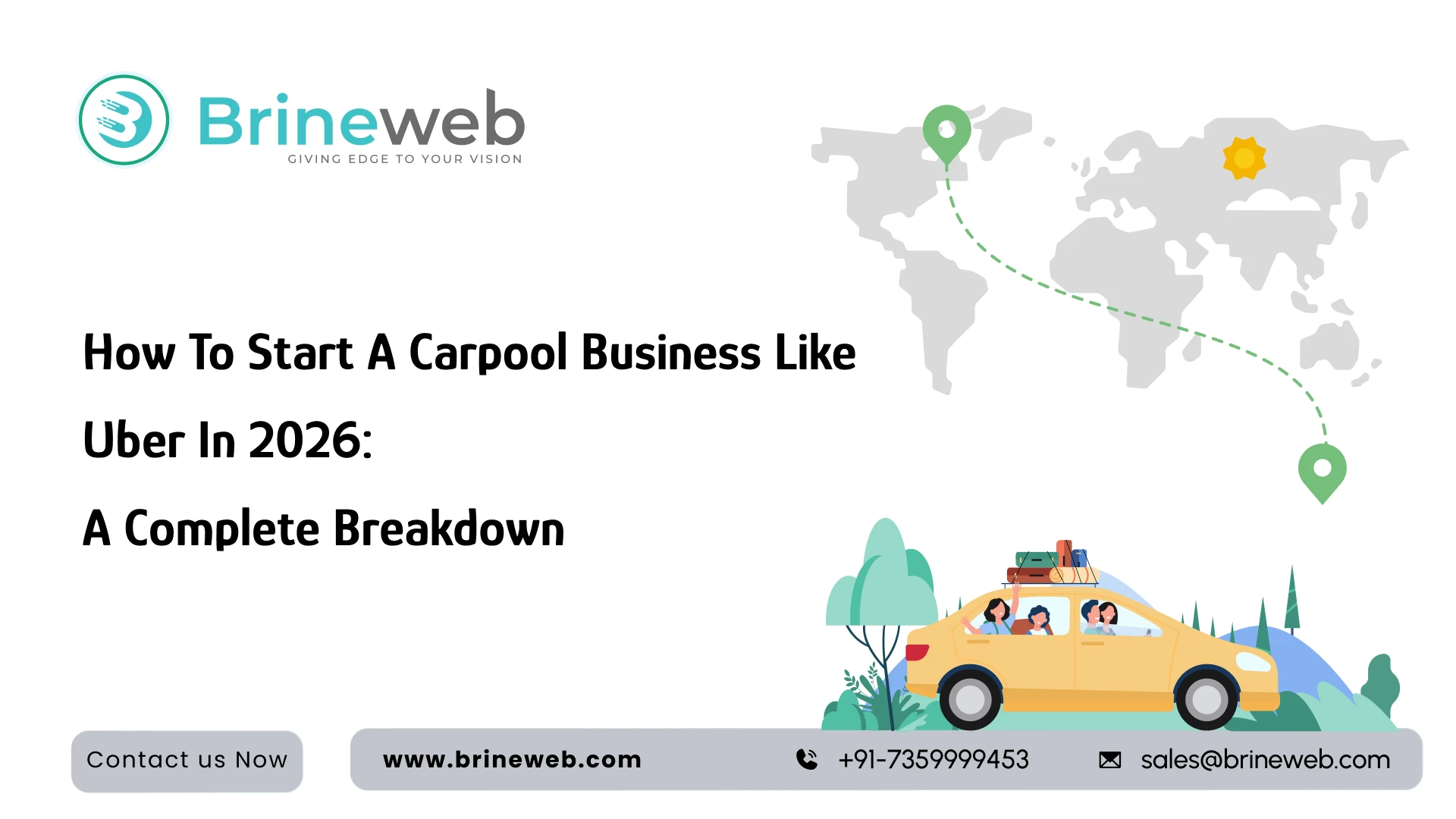
The carpooling market reaches $12.96 billion in 2025 and grows to $28.1 billion by 2032. Here is a complete breakdown of how to start a carpool business, from choosing your model and getting licensed to building your app and landing your first users.
Why Carpooling Is a Genuine Business Opportunity in 2026
The carpooling market was valued at $12.96 billion in 2025 and is projected to reach $28.1 billion by 2032 at a 16.8% CAGR. App-based carpooling registrations grew 22% globally in 2024 to 2025. India became BlaBlaCar's largest market in 2025, accounting for roughly one-third of the company's worldwide carpooling activity with nearly 20 million passengers expected in India alone.
Three forces are driving this simultaneously.
Rising fuel costs are making shared rides economically compelling even for people who would otherwise prefer the convenience of a solo trip. Urban congestion is making carpooling faster in many corridors where a high-occupancy vehicle lane cuts 20 minutes off a morning commute. And corporate ESG mandates are creating active institutional demand from sustainability directors who need to reduce Scope 3 employee commute emissions and produce verifiable data to prove it.
The result is a market with genuine consumer demand, institutional B2B demand, and no dominant player in many geographies. BlaBlaCar leads in Europe and is growing fast in India. Uber Pool and Lyft Line exist but are add-on features within larger ride-hailing apps rather than dedicated carpool products. In Southeast Asia, Latin America, Africa, and most of North America outside major cities, a focused carpool operator can build a defensible position before the global platforms prioritise the category.
Carpool vs Ride-Hailing: What Is Actually Different
Most people assume carpooling is just a cheaper version of Uber. It is structurally different in three ways that matter for business.
Who drives. In ride-hailing, a professional driver picks you up and gets paid for the service. In carpooling, a regular driver heading to the same destination gives you a seat and typically shares fuel costs rather than earning a professional income. This distinction changes the legal classification of the service in most markets.
Unlike carpooling, Uber's taxi app business model relies on professional drivers completing individual passenger trips.
Who regulates it. Because the carpool driver is not a professional-for-hire in the same legal sense as an Uber driver, the regulatory framework is often less onerous. In most markets, carpooling is regulated differently from commercial passenger transport and frequently benefits from lower licensing requirements.
How revenue works. Uber earns commission on every professional fare. BlaBlaCar earns a booking fee from the passenger on every ride, not a commission from the driver. The driver recovers fuel cost. The platform earns a transaction facilitation fee.
This makes the economics of carpooling meaningfully different from ride-hailing and changes your market entry strategy, your technology requirements, and your licensing pathway.
If your model involves professional drivers rather than cost-sharing, you may want to explore how to start a ride-hailing business instead.
Three Business Models to Choose From
Model 1: Consumer P2P Carpool (BlaBlaCar Model)
Drivers post available seats on planned trips. Passengers search, match, and book. You earn a booking or service fee per transaction, typically 15 to 20% of the passenger's payment.
This model works best for intercity trips of 50 to 500 kilometres where the cost saving versus train or bus is significant and the social trust element (verified profiles, two-way ratings) resolves the stranger-in-a-car concern. BlaBlaCar perfected this model over 20 years across Europe and is now scaling it globally.
The BlaBlaCar business model shows how a platform can monetize shared journeys without operating its own vehicle fleet.
Model 2: Daily Commuter Carpool (Waze Carpool, Scoop Model)
Commuters in the same area who work at the same destination or along the same corridor match for recurring daily carpools. Drivers recover fuel costs. Passengers pay slightly below a standard taxi fare.
This model generates recurring bookings rather than one-off trips, which gives you higher per-user revenue and better retention than intercity carpool. The matching logic is harder to build because it requires both location and schedule matching simultaneously. Corporate partnerships are the most efficient customer acquisition channel here because one employer with 500 employees generates hundreds of potential matches in a single geographic cluster.
Model 3: Corporate Enterprise Carpool
You build carpool management software for employers rather than a consumer-facing marketplace. The employer pays a per-employee or per-month licence fee. Employees use the app to match carpools with colleagues. The employer gets Scope 3 emissions reporting, parking reduction data, and employee commute satisfaction metrics.
The Gojek business model is another example of how mobility can become one part of a much broader on-demand ecosystem.
This B2B model requires longer sales cycles and more complex product features including HR system integration, multi-location routing, and ESG reporting dashboards. But corporate clients have budgets, low churn once integrated, and are actively seeking solutions in 2026 because Scope 3 reporting mandates are becoming enforceable.
Step 1: Choose Your Entry Niche
Do not try to build all three models at once. Pick the niche with the clearest demand in your target market and prove it before expanding.
Intercity corridor carpooling. Identify the two or three highest-volume intercity routes in your country where public transport is inadequate or expensive. Launch on those routes only. BlaBlaCar's playbook was exactly this: dominate specific corridors before building a national network.
Corporate commute carpooling. Identify employers with 200 or more employees in suburban locations poorly served by public transport. Your first sale is the employer, not the individual employee. One corporate client gives you a captive pool of potential carpool matches.
University and campus carpooling. Students have predictable commute schedules, strong price sensitivity, and social trust within their institution. A campus-specific carpool app faces less liability complexity than a general public platform and can build density quickly within a contained community.
Airport corridor carpooling. Fixed routes from residential suburbs to major airports. High value per trip. Passengers are comfortable pre-booking. Predictable schedules make matching easier than general carpooling.
Step 2: Understand the Legal Framework
This step varies significantly by market and is the one founders most frequently skip until it creates a problem.
The core legal question is whether your platform is operating as a commercial passenger transport service (which requires taxi or transport operator licences) or as a cost-sharing facilitation service (which typically does not).
In most markets, a carpool platform where the driver recovers fuel cost but does not earn a profit from the trip is classified as ride-sharing rather than commercial transport. This is the classification that allows BlaBlaCar to operate without drivers holding professional driving licences.
The moment a driver earns more than their actual costs, or the platform positions the service as professional transport, the commercial classification may apply.
Key requirements in major markets:
In the UK, carpooling for cost-sharing is generally legal without specialist licensing. Commercial passenger transport requires PHV operator licensing. Make your pricing framework and terms of service explicitly clear that drivers recover costs, not profit.
In the US, regulations vary by state. Some states have explicit carpooling exemptions from commercial transport rules. Others do not. Legal counsel in each state you operate is essential before launch.
In India, where carpooling demand is massive, the Motor Vehicles Act governs carpooling. Most states permit non-commercial ride-sharing but the boundary between carpooling and commercial aggregation is a grey area that requires careful structuring.
In the UAE, Dubai's RTA has a specific framework for carpooling services. Confirm your model aligns with the current framework before registering.
The safer your legal structure, the more clearly your platform facilitates cost-sharing rather than commercial transport, the less regulatory friction you face.
Step 3: Register Your Business
Standard business registration applies regardless of carpooling model.
Register as an LLC or equivalent limited liability entity in your jurisdiction. This protects personal assets if a passenger incident results in a claim against the platform.
Get your business tax registration and any applicable technology or marketplace operator licences from your local authority.
For the B2B corporate model, register as a software service provider and prepare appropriate contracts for employer clients covering data processing, liability, and service levels.
Step 4: Build Your Carpool App
A carpool app has different requirements from a standard ride-hailing app. The matching logic is more complex. The trust infrastructure is more important. And the scheduling layer needs to handle both real-time and pre-planned trips.
The Four Core Components
Passenger app. Search for available rides by route, date, and time. View driver profiles with verification badges, ratings, and trip history. Book and pay within the app. Real-time notifications for booking confirmation, driver updates, and trip reminders. In-app messaging with driver through masked number or chat. GPS tracking during active trips. SOS emergency alert button.
Driver app. Post available trips with route, date, time, and available seats. Set contribution per seat. Manage booking requests (accept or decline). Navigate to passenger pickup with GPS. Confirm pickup and completion. Earnings dashboard showing trip contributions received.
Admin dashboard. User verification queue management. Dispute resolution and refund processing. Route and corridor analytics. Driver and passenger rating monitoring. Fraud detection alerts. Corporate account management for B2B clients.
Corporate portal (for B2B model). Employee carpool matching within the organisation. Employer dashboard showing active carpools, commute reduction metrics, carbon savings data, and Scope 3 reporting outputs. HR system integration for employee onboarding. Employer billing and admin controls.
Trust Infrastructure Is Non-Negotiable
Carpooling puts strangers in cars together. Every serious platform needs government-issued ID verification during driver onboarding, OTP-based phone confirmation for all users, two-way ratings visible before booking, in-app messaging that keeps personal contact information private, and an SOS button that triggers an emergency response during active trips.
These features are not differentiators. They are table stakes. A carpool platform that launches without them will face a serious incident eventually and have no defence.
Step 5: Revenue Model
Booking fee per transaction. The BlaBlaCar model. Charge passengers a service fee of 15 to 20% on top of the driver's requested cost contribution. The driver receives their contribution in full. You keep the booking fee.
Corporate licence fees. Monthly or annual B2B contracts with employers. Typically priced per employee or per active carpooler per month. High lifetime value. Low churn.
Premium subscription for drivers. Verified driver badge, priority listing in search results, and analytics dashboard for a monthly fee. Small per-driver revenue that adds up as your driver base grows.
Carbon credit partnerships. As verified carpooling reduces vehicle trips and emissions, some jurisdictions allow carbon credits to be generated and sold. This is early-stage but growing in markets with carbon pricing mechanisms.
Surge fees on high-demand routes. Higher booking fees during major events, holiday travel peaks, or severe weather when demand significantly exceeds supply.
For the full range of revenue mechanics that apply to taxi, ride-sharing, and carpooling platforms, our taxi app revenue model guide covers every monetisation layer in detail.
Step 6: Launch Strategy
Intercity Carpool Launch
Pick two cities connected by a high-demand corridor. Launch driver supply first with zero commission for the first three months. Drivers list trips because it costs nothing. Passengers find rides because the selection is there. Once you have 50 active drivers on the route, launch passenger marketing.
Target student and young professional communities first. They are price-conscious, tech-comfortable, and socially comfortable with carpooling in a way that older demographics sometimes are not.
Corporate Carpool Launch
Identify three to five employers in the same suburban business park or industrial estate. Offer a free three-month pilot. Build their employee matching pool and produce a monthly commute and carbon reduction report. Use that report as your sales case for the next employer.
One successful corporate pilot is worth more than ten months of consumer marketing in terms of closing the next B2B contract.
Community and Campus Launch
Partner directly with the institution. University transport offices, HR departments, and sustainability teams are all actively looking for commute solutions. A university endorsement gives you instant credibility with the student base and removes the cold-start problem of your first users not finding matches.
Step 7: Cost to Launch
White-label carpool app: $15,000 to $40,000. Launches in 4 to 8 weeks. Covers core matching, booking, payments, and trust features.
Custom carpool app (mid-level): $50,000 to $120,000. Takes 5 to 10 months. Full feature set including advanced matching algorithms, real-time trip tracking, and corporate portal.
Enterprise B2B corporate carpool platform: $80,000 to $200,000. Multi-tenant architecture, HR integrations, ESG reporting dashboards.
Business registration and legal: $500 to $5,000 depending on market and legal complexity.
Driver and passenger acquisition: $5,000 to $20,000 per launch corridor.
Total minimum viable launch: $20,000 to $65,000 for a consumer carpool app covering one corridor.
For context on how these costs compare to a standard ride-hailing app launch, our food delivery app development cost guide covers the full cost breakdown for all four platform components. The same architecture applies to carpool apps with the addition of the matching and scheduling layer.
What Makes a Carpool Business Succeed
Matching quality determines everything. The number one reason carpool apps fail is poor matching, drivers and passengers who technically overlap in route but whose timing, pickup points, or preferences make the match impractical. Invest in your matching algorithm before you invest in marketing. A platform where 70% of searches return at least one viable match retains users. One where 40% do not retains nobody.
Trust builds slowly and dies fast. A single serious safety incident that is handled poorly can permanently damage a carpool platform's reputation. Build your trust infrastructure before launch, not after something goes wrong. Verification, ratings, in-app communication, and emergency features are not features you add when you have budget. They are features you launch with.
Corporate B2B provides the economic foundation. Consumer carpool is high volume, low margin. Corporate carpool is lower volume, high margin, and recurring. The platforms that reach profitability fastest are the ones that build B2B alongside consumer from the start rather than treating corporate as a later-phase product.
Density in one corridor beats thin coverage everywhere. A platform with 200 active users on the London to Birmingham corridor provides better matches than one with 2,000 users spread across 50 routes. Build density in one corridor first.
How Carpool Compares to Ride-Hailing as a Business
Starting a carpool business requires less capital than starting a ride-hailing platform because you don't need professional driver networks, commercial vehicle licensing infrastructure, or the driver supply density that makes a ride-hailing marketplace viable.
The Rapido business model also shows how an existing driver network can be used across multiple mobility and delivery services.
But it also requires different thinking. For how the ride-hailing business model compares structurally, and what it takes to run a platform with professional drivers versus a cost-sharing carpool network, our Uber clone startup guide covers the ride-hailing launch process end to end. Reading both in parallel clarifies which model better fits your market and capital position.
Ready to Build Your Carpool App?
The carpooling market grows at 16.8% annually through 2032. The intercity, commuter, and corporate carpooling segments are all growing. The technology to build a competitive carpool platform is more accessible than at any point in the category's history.
You need a clear first corridor or first corporate client, a trust infrastructure that makes passengers feel safe in a stranger's car, and a matching algorithm that returns useful results on the first search.
Brine Go by Brineweb gives you a white-labeled mobility platform that can be configured for carpool and ride-sharing alongside standard taxi. Passenger app, driver app, real-time GPS, payment processing, and admin console, configurable for your model and market.
Get a free quote from Brineweb and find out what it costs to launch your carpool platform.