info@brineweb.com
 +91 73599 99453






























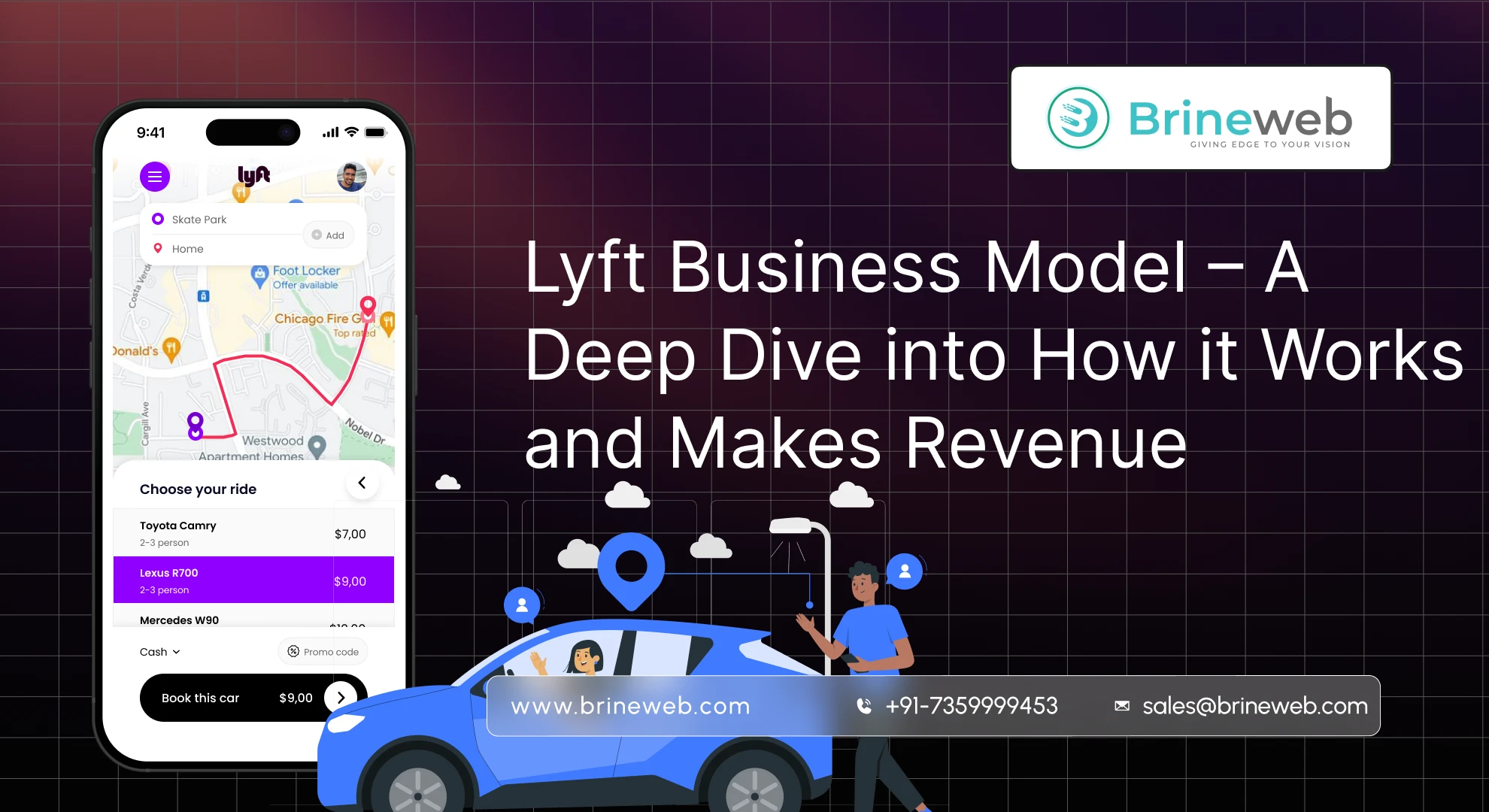
Everyone says Lyft is like Uber. And from the outside, it looks the same. You open the app, book a ride, a driver shows up, you pay digitally.
But the real story is not the app. The real story is the economics behind it.
If you are building a taxi app, a ride-hailing startup, or studying how marketplace businesses actually work, understanding Lyft's model matters more than copying its features. Let's get into it.
What Is Lyft?
Lyft is a ride-hailing platform that connects two groups riders who need transportation and drivers who use their own vehicles to provide it. Founded in 2012 by Logan Green and John Zimmer, Lyft operates in 644 U.S. cities and 12 Canadian locations.
Unlike Uber, Lyft chose depth over width. Instead of chasing global expansion, it focused almost entirely on North America. That strategic decision shapes everything about how the business runs.
If you want to build something similar from the ground up, check out Brineweb's ready-to-launch taxi app platform built for founders who want Lyft-like functionality without starting from zero.
The Core Model: A Two-Sided Marketplace
Lyft runs what economists call a two-sided marketplace. On one side you have riders. On the other you have drivers. Lyft sits in the middle and controls the matching, pricing, payments, support, and safety systems.
What Lyft does not do is own most of the vehicles or employ drivers directly. Drivers work as independent contractors. This is an asset-light platform model, and it matters because
- Lyft avoids massive capital costs tied to owning a fleet
- The business scales without proportional cost increases
- Operational risk shifts largely to drivers
The downside? Driver loyalty is fragile. Anyone with a car can drive for a competitor tomorrow. This is a core tension every ride-hailing business faces from day one.
How a Ride Actually Works
The operational flow is simple on the surface:
- You open the Lyft app and enter your destination
- Lyft calculates a fare estimate using distance, time, and demand data
- Nearby drivers receive the request
- A driver accepts and comes to you
- The ride happens
- Lyft processes payment in-app automatically
- Lyft takes its cut and the driver receives the rest
Every revenue stream Lyft has flows through this structure.
How Lyft Makes Money
1. Commission Per Ride
This is the engine. Lyft takes roughly 20% to 30% commission on every fare, depending on the market. The driver keeps the rest.
It scales beautifully. More rides mean more commission with no proportional increase in cost. In 2024, Lyft processed 828 million rides across its platform. That volume is where the real money sits.
Owning the transaction is the key. Drivers cannot charge riders outside the platform officially, which means Lyft controls every dollar that flows through the system.
2. Service and Booking Fees
On top of commission, Lyft charges riders small booking fees and service fees per trip. Individually these are easy to miss. At hundreds of millions of rides per year, they add up fast.
3. Prime Time Pricing (Dynamic Pricing)
When demand outpaces available drivers, Lyft raises fares automatically. This does two things at once it pushes more drivers to go online to earn more, and it generates higher revenue per ride. Higher fares also mean higher commissions.
This is not arbitrary. It is a supply and demand balancing mechanism that keeps the marketplace liquid during peak hours.
4. Lyft Pink (Subscription Model)
Lyft Pink is Lyft's subscription program. Members pay a monthly fee and get discounted rides, priority pickups, and reduced cancellation fees.
For Lyft, this creates predictable recurring revenue. For riders, it builds loyalty and makes switching feel like a real cost. Subscription models smooth out the demand volatility that hurts most on-demand businesses.
5. Cancellation Fees
When riders cancel late or leave drivers waiting too long, Lyft charges a cancellation fee. These protect driver time, discourage platform abuse, and generate additional income at scale.
6. Corporate and Business Programs
Lyft Business serves companies that need to transport employees, clients, or patients. Corporate clients ride more frequently, plan in advance, and are less price-sensitive than individual consumers. This makes B2B a high-margin, predictable segment for Lyft.
7. Bikes and Scooters
Lyft expanded into micromobility through bike-sharing and electric scooters. These shorter trips generate additional usage frequency and extend Lyft's reach into commutes that cars cannot serve as efficiently.
The Numbers Behind the Business
Lyft reported $5.8 billion in revenue for 2024, up 31% year over year. Gross bookings hit $16.1 billion. After years of losses, 2024 marked Lyft's first full year of GAAP profitability, with net income of $22.8 million.
Average revenue per active rider reached $55.85 in 2024, and the platform served 44 million annual riders.
The Cost Structure: Why Margins Stay Tight
Revenue looks clean. Costs tell a messier story.
Lyft's major expenses include driver incentives, technology infrastructure, cloud hosting, insurance, customer support, marketing, and legal and compliance costs.
Driver incentives are especially heavy. To keep supply healthy, Lyft runs sign-up bonuses, guaranteed earnings for new drivers, and referral programs. Marketplaces live or die by supply-demand balance, and maintaining that balance is expensive.
This is why ride-hailing margins stay thin even at scale.
Lyft vs. Uber: The Real Difference
On paper the models look identical. In practice, they diverged years ago.
Uber went global fast and diversified into food delivery, freight, and other verticals. During the pandemic, Uber Eats kept revenue coming in while rides collapsed. Lyft had no such safety net. Lyft's rides dropped around 80% in April 2020 compared to the year before.
Lyft's narrower focus reduces complexity and keeps management attention concentrated. But it also limits upside and leaves the business exposed to single-market disruptions.
For startups, Lyft's approach is often more realistic than Uber's. Win one region before you think about the next one. This is exactly the philosophy behind Brineweb's on-demand app development approach, where you launch a focused, market-ready product before scaling.
Network Effects: The Invisible Growth Engine
Lyft benefits from a powerful network effect loop. More riders attract more drivers. More drivers mean faster pickup times. Faster pickups attract more riders.
But network effects are not automatic. They require careful local supply management. Without enough drivers, riders leave. Without enough riders, drivers leave. This balance needs constant attention, which is why both Lyft and Uber keep spending on driver incentives even after achieving scale.
What Lyft Is Really Selling
Lyft is not selling rides. It sells time savings, predictability, and friction removal. The ride is just the delivery mechanism for those things.
You do not open Lyft because you love the app. You open it because you want to stop thinking about transportation for the next 20 minutes. That insight matters if you are building anything in this space. Build around the outcome users want, not the feature that delivers it.
This is what separates average apps from ones that actually retain users. If you are working toward that kind of product, Brineweb's taxi app gives you a proven foundation so you can focus on market fit instead of rebuilding core infrastructure.
The Future of the Model
Lyft is investing in autonomous vehicle partnerships, subscription expansion, and AI-driven pricing optimization. Autonomous vehicles represent the most significant potential shift. If drivers are no longer needed, fixed costs drop dramatically and margins could improve significantly.
That future is still developing. But it is the reason ride-hailing companies have spent billions on self-driving technology despite years of losses.
What Founders Can Take From This
Lyft's model is not complicated at its core. Connect supply and demand. Take a commission. Manage trust and payments. The complexity lives in the execution balancing both sides of the marketplace, handling regulations, managing incentives, and competing with a better-funded rival.
If you are planning to build a ride-hailing app, you do not need to figure all of this out from scratch. Brineweb builds custom on-demand taxi apps with driver and rider apps, admin panels, dynamic pricing logic, and everything else baked in. You bring the market. They bring the product.
Study Lyft for the economics, not just the interface. In platform businesses, the interface is visible. The economics are invisible. And the economics decide who survives.