info@brineweb.com
 +91 73599 99453





























Blinkit is India's leading quick-commerce platform that delivers groceries, electronics, medicines, and daily essentials in under 10 minutes through a network of dark stores. It makes money through product margins on its own inventory, commissions from third-party brand listings, delivery fees, in-app advertising, and subscription memberships.
In Q1 FY26, Blinkit reported revenue of ₹2,400 crore, a 156% year-on-year jump, and a Gross Order Value of ₹11,821 crore. It commands 45% of India's quick-commerce market, ahead of Swiggy Instamart at 27% and Zepto at 21%. Goldman Sachs values Blinkit at $13 billion, making it worth more than Zomato's own food delivery business.
This is the full story of how Blinkit works, what changed in its model in 2026, and what founders building delivery platforms can take from it.
What Is Blinkit?
Blinkit, formerly known as Grofers, was founded in December 2013 by Albinder Dhindsa and Saurabh Kumar. It started as a scheduled grocery delivery platform but struggled with reliability when it depended on local stores for fulfillment. The company rebranded to Blinkit in 2021 to reflect its pivot to instant delivery. In August 2022, Zomato acquired Blinkit in an all-stock deal valued at approximately $568 million.
Today Blinkit operates over 1,816 dark stores across more than 30 Indian cities as of September 2025, with a target of 3,000 dark stores by March 2027. It delivers over 1.2 million daily orders, stocks 6,000 to 10,000 SKUs per dark store, and has pushed its average order value above ₹650 through a strategy of stocking premium products including iPhones, PlayStation consoles, and electronics alongside everyday groceries.
What Is Blinkit's Dark Store Model?
A dark store is a micro-warehouse that looks like a small retail shop but is closed to the public. It is staffed by packers who pick, scan, and pack orders in 2 to 3 minutes, after which a delivery partner picks up the order and reaches the customer in 8 to 12 minutes total.
Blinkit sets up dark stores of approximately 3,000 square feet within a 2 to 4 kilometre radius in high-density urban areas, often in basements or back lanes where rent is lower. Each dark store serves a defined geographic catchment. When you order on Blinkit, the app automatically connects your order to the nearest dark store with available stock.
This hyperlocal approach is the operational foundation of the 10-minute delivery promise. The speed does not come from fast driving. It comes from having inventory physically close to the customer before the order is even placed. AI algorithms predict demand and automate stock levels, a strategy increasingly important in AI-powered grocery delivery apps. Blinkit's proprietary Store Operating System uses machine learning to cut perishable wastage to below 2%, which directly protects margins in the grocery business.
As of Q2 FY26, approximately 90% of Blinkit's sales flow through its own inventory under a first-party model, with third-party vendor listings accounting for the remaining 10%. This shift from marketplace to inventory-led is the single biggest strategic change in Blinkit's model and it is reshaping how the platform makes money.
The 2026 Model Shift: From Marketplace to Inventory-Led
Until 2025, Blinkit primarily operated as a marketplace. Brands listed their products, Blinkit earned commissions on sales, and the inventory belonged to the sellers. This created quality control problems sellers had inconsistent stock, pricing varied across listings, and Blinkit had limited ability to guarantee delivery times when a product was out of stock at a specific store.
From September 1, 2025, Blinkit shifted to a fully inventory-based first-party model. Under this model, Blinkit directly purchases goods from brands and sellers, stores them in its own dark stores, issues invoices under its own GSTIN, and acts as the legal seller. This gives Blinkit complete control over product quality, pricing consistency, stock availability, and delivery speed.
The trade-off is higher capital intensity. Owning inventory ties up working capital. But it also means Blinkit captures the full product margin rather than just a commission, improves the customer experience through consistent stock availability, and makes its logistics planning far more predictable.
Blinkit CEO Albinder Dhindsa has stated: "We don't believe you can build a strong quick commerce business on the back of heavy discounting. The tougher answers to growth are the only ones that last."
How Blinkit Works: The Full Order Flow
The process works across four coordinated stages that together take under 12 minutes from tap to doorbell.
You open the Blinkit app, enter your location, and browse products available at your nearest dark store. The app shows real-time stock availability. You add items to the cart and pay through UPI, card, wallet, or cash on delivery.
The order instantly reaches the assigned dark store. Store staff receive a pick list on their device and physically move through the warehouse picking, scanning, and packing each item in 2 to 3 minutes. The store has everything in a fixed location with QR-coded bins so staff do not waste time searching.
The system simultaneously assigns the nearest available delivery partner and calculates the fastest route using live traffic data. When the order is packed, the rider picks it up and delivers it directly to your door. You can track the order live throughout.
On average, the full process takes 8 to 12 minutes in metro areas. The post-Zomato acquisition also brought shared delivery fleets and logistics optimisation that reduced the cost per delivery and opened cross-selling opportunities across Zomato's food ordering user base.
Blinkit's Revenue Model: How It Makes Money
1. Product Margins on Own Inventory
Since the shift to the first-party model, Blinkit's primary revenue comes from the margin it earns buying goods from suppliers and selling them at retail prices. This margin varies by category, with packaged groceries running lower margins and electronics, beauty, and private-label products running significantly higher. Revenue in Q1 FY26 reached ₹2,400 crore, a 156% year-on-year increase.
2. Commission from Third-Party Brand Listings
The remaining 10% of sales flow through third-party brand listings. FMCG companies and niche brands pay Blinkit a commission on every completed order, typically 10 to 20% depending on category and partnership terms. This provides incremental revenue without Blinkit taking on inventory risk for those products.
3. Delivery Fees
Blinkit charges customers a delivery fee that varies based on distance, order size, and surge demand. Smaller orders attract higher fees. Subscriber orders receive free delivery above a minimum. Delivery fee revenue grows as Blinkit expands into Tier 2 cities where average order values are lower but order frequency is increasing rapidly.
4. In-App Advertising and Sponsored Listings
Blinkit operates a retail media platform where FMCG brands pay for sponsored product placements, featured category banners, and search result prominence. A brand that wants its product seen first when a user searches for "shampoo" or "chips" pays Blinkit for that placement. Retail media is the highest-margin revenue line in any large-scale delivery platform. It requires no physical inventory, no delivery cost, and scales directly with daily active users.
5. Subscription: Smart Bachat Club
Blinkit's paid membership provides free delivery for orders above ₹4,000 and exclusive discounts. Approximately 10% of revenue comes from these subscriptions. Subscribers order more frequently and spend more per session than non-subscribers, making each subscriber significantly more valuable to the platform than the fee alone suggests.
6. Private Label Products
Blinkit sells its own branded products in staples, snacks, and personal care. Private label carries higher margins than branded alternatives since there is no manufacturer margin embedded in the cost. This is a growing lever as the first-party inventory model deepens.
7. Data Insights for Brands
Blinkit sells anonymised consumer behaviour data and regional demand insights to brands. Brands use these insights to plan smarter inventory and marketing decisions. This is an early-stage revenue line that scales naturally as data volume grows.
The Numbers: Blinkit's Financial Performance
Full-year FY24 revenue was ₹2,301 crore, growing 122% year on year. Q4 FY25 revenue hit ₹1,709 crore with GOV of ₹9,421 crore, growing 134% year on year. Q1 FY26 accelerated to ₹2,400 crore revenue and ₹11,821 crore GOV at 156% year-on-year growth. In Q2 FY26, revenue reached ₹9,891 crore, nearly 9 times the ₹1,156 crore reported a year earlier.
By late 2024, Blinkit achieved contribution positivity across its entire store network. Eternal Ltd invested ₹2,600 crore into Blinkit across 2025 and early 2026 to fund continued dark store expansion.
Blinkit vs Zepto vs Swiggy Instamart
Blinkit holds 45% of India's quick-commerce market. Swiggy Instamart holds 27% and Zepto holds 21%. New entrants including Flipkart Minutes, Amazon Fresh, and Reliance JioMart are expanding but remain smaller.
Blinkit's lead comes from three structural advantages. It has the densest dark store network in key metros like Delhi-NCR and Bengaluru, producing better delivery economics and faster SLAs. Its integration with Zomato gives cross-selling access to tens of millions of food delivery users. And its first-party inventory model gives pricing control and stock reliability that marketplace models cannot match.
The same depth-first expansion logic that made Snabbit challenge Urban Company in home services applies directly here. Blinkit's micro-market density strategy is why its per-store economics outperform competitors who spread supply thinner across more geography. The Snabbit vs the Giants blog covers this same hyperlocal depth principle in the context of instant home services.
Quick-commerce platforms like Blinkit sit within a broader on-demand delivery ecosystem alongside pure food delivery giants if you want to understand how UberEats makes money through restaurant commissions, delivery fees, and advertising, the contrast with Blinkit's inventory-led model becomes especially instructive.
What Founders Building Delivery Platforms Can Take From This
Own your inventory before you own your market. Blinkit's most important decision was shifting from third-party marketplace to first-party ownership. This gave it quality control, pricing consistency, and delivery reliability that no marketplace model can guarantee. If you build a delivery platform and depend entirely on third-party sellers, you have no control over the thing customers care about most: whether the item is actually there when they order it.
Dark store density beats geographic coverage. Blinkit concentrates dark stores so densely in high-demand urban clusters that its per-delivery economics improve with every new store added nearby. Spreading thin across a wide geography produces mediocre service everywhere. Concentrating in a few micro-markets produces excellent service somewhere, which builds the reputation that earns the next expansion.
Retail media is where the margin lives. Grocery delivery margins are structurally thin. The high-margin revenue in any large-scale delivery platform is advertising. A brand paying for sponsored placement costs the platform nothing in inventory or logistics but generates pure margin. Build your advertising infrastructure early, even if it is small at launch.
Premium SKUs change the economics. Blinkit's decision to offer iPhones and electronics alongside groceries lifted average order value from ₹450 to over ₹650. Higher average order value on the same delivery infrastructure dramatically improves per-trip economics.
The same full-stack ownership that makes Blinkit's model defensible is what made Urban Company's home services platform defensible both chose to control quality at every step rather than just facilitate the transaction.
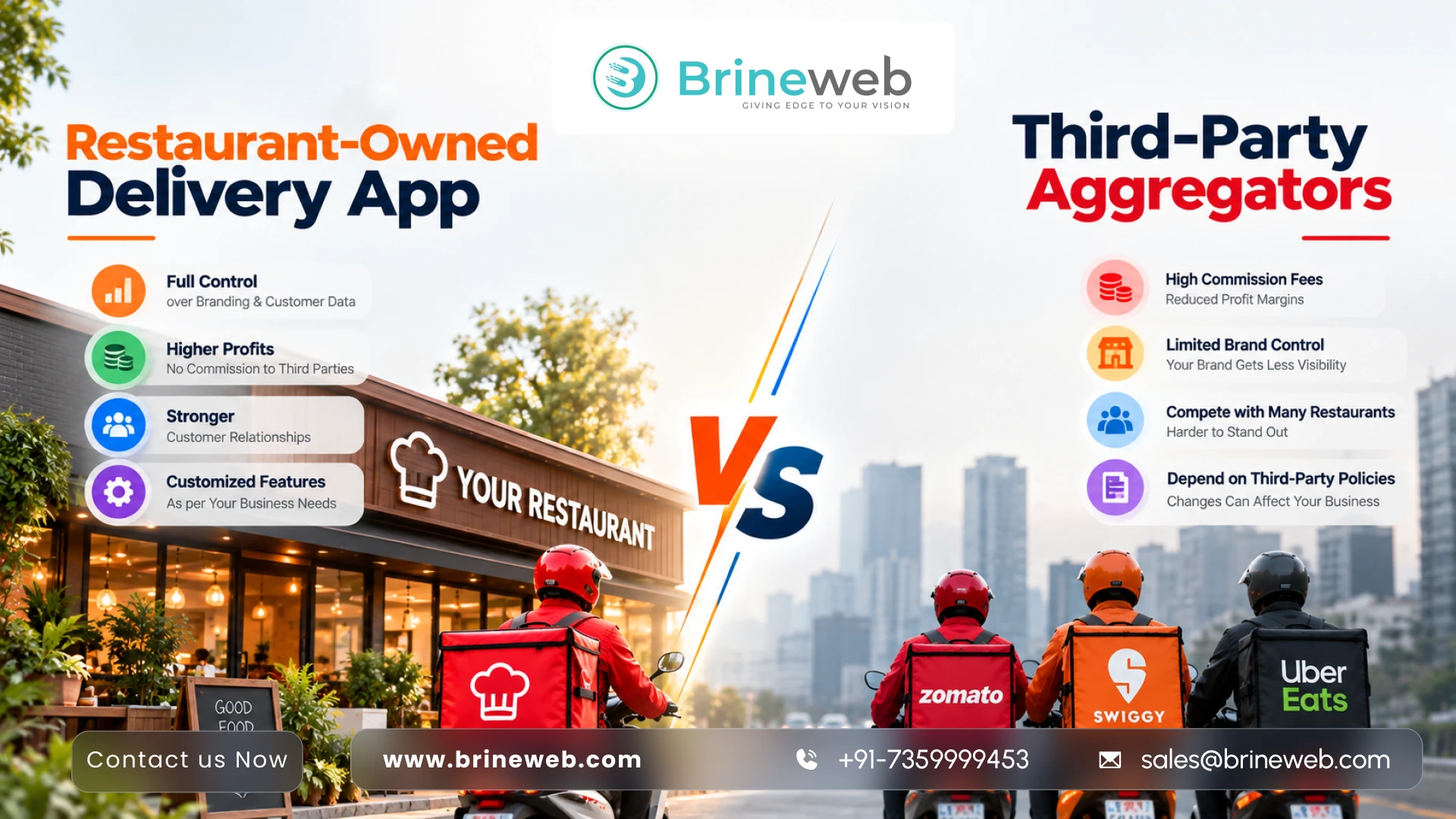
If you are building a delivery app for food, groceries, pharmacy, or any on-demand category, Brineweb's delivery app solution gives you a production-ready platform covering customer app, delivery partner app, real-time GPS tracking, live order management, payment integration, and admin console. You bring the dark store strategy. The technology is already built.
For founders deciding between building from scratch or launching with a proven foundation, our clone app vs custom app development guide walks through exactly when each approach makes sense based on your stage and budget.
Challenges Blinkit Faces
Owning inventory ties up significant working capital. Seasonal demand, perishable wastage, and supply disruptions all become Blinkit's problem to manage. Competition is intensifying Reliance JioMart processes approximately 1.6 million daily orders, and Flipkart Minutes and Amazon Fresh are both expanding aggressively. Regulatory uncertainty around gig worker classification could materially change delivery cost structures. And full EBITDA profitability at the group level is still being established as Blinkit invests in expansion ahead of returns in new markets.
The Future of Blinkit
Blinkit targets 3,000 dark stores by March 2027, up from 1,816 in September 2025. The high-value SKU strategy and Blinkit Print are expanding. Retail media is still early but growing fast as FMCG brand investment in quick-commerce advertising increases. International expansion into markets with high urban density, strong smartphone penetration, and a preference for convenience remains a strategic option Eternal Ltd has not yet exercised.
Ready to Build Your Own Delivery App?
Blinkit proved that fast delivery is not just a feature, it is a business. Every operational decision from dark store placement to premium SKU strategy serves the 10-minute promise that keeps customers coming back daily.
You do not need to build all of that infrastructure from scratch. Brineweb's delivery app solution covers the full technology stack for any on-demand delivery business. If you're comparing development budgets, features, timelines, and white-label versus custom development, our food delivery app development cost guide breaks down the numbers in detail.
Get a free quote from Brineweb and find out what it costs to launch a delivery platform built for your market.