info@brineweb.com
 +91 73599 99453


























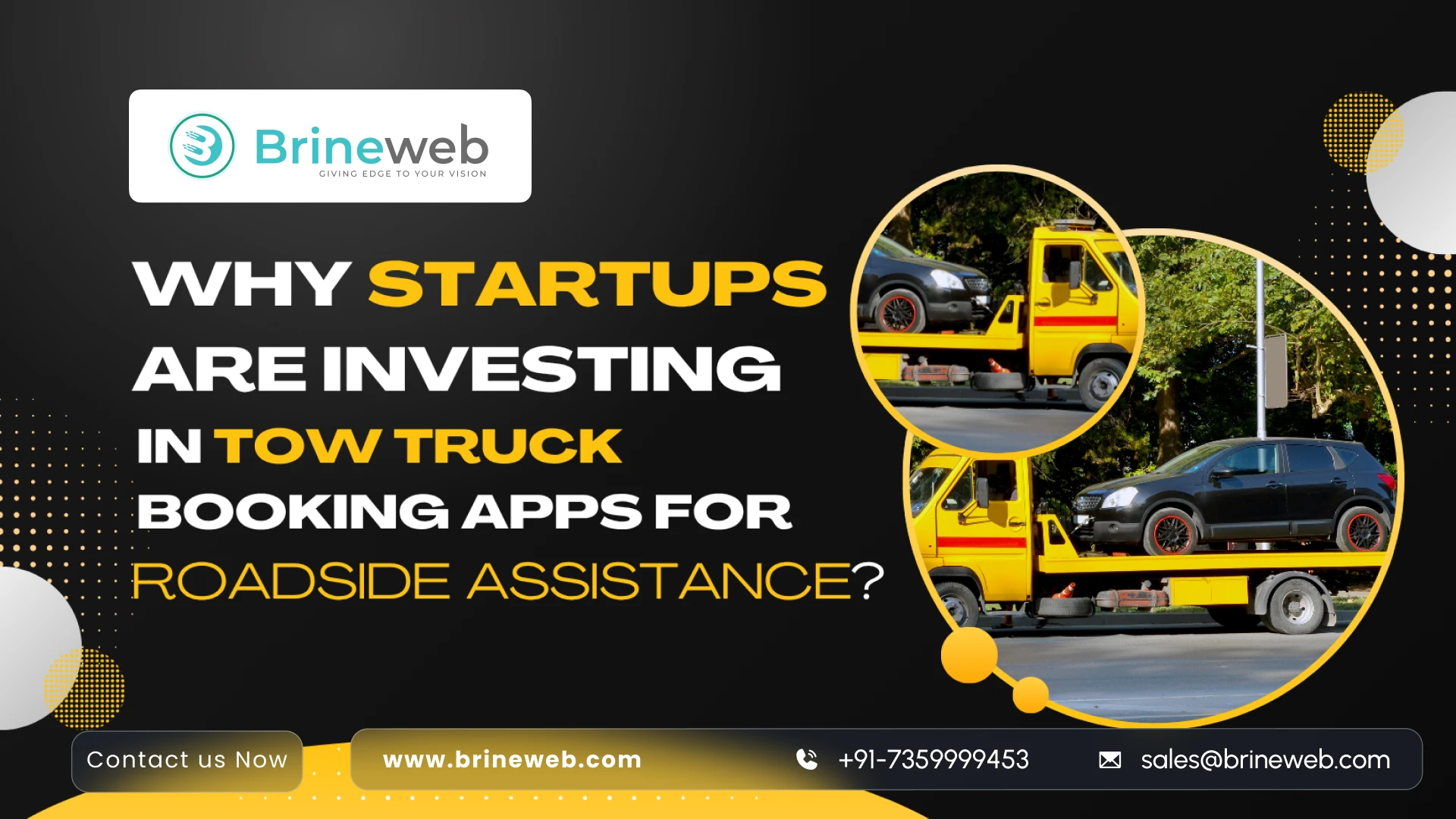
The global roadside assistance market hits $28.67 billion in 2026. Low digital competition, high insurance demand, and recurring B2B revenue are the three reasons startups are pouring money into tow truck booking apps right now.
The Category Nobody Expected to Go Digital
The vehicle roadside assistance market is estimated at USD 28.67 billion in 2026 and is expected to reach USD 41.98 billion by 2033, growing at a CAGR of 5.6%.
Towing holds the largest share at 42.5% of that market. Battery jump-starts, flat tyre assistance, fuel delivery, and lockout services make up the rest.
What makes this category particularly interesting to startups in 2026 is not the size. It is the gap between the size and the digital penetration. Most of this $28.67 billion market still runs on phone calls. A driver breaks down, calls a number from a roadside assistance card, waits on hold, gets an uncertain ETA, and hopes the tow truck shows up before dark.
This shift in customer behaviour is exactly why the Uber for Tow Trucks model is becoming one of the fastest-growing on-demand service models in the world.
The market is large. The digitisation gap is wide. The competitive field has few serious digital players outside Honk and Urgent.ly in the US. In most markets globally, the category is essentially untouched by modern app development.
That combination, large market, low digital competition, clear customer pain, is the same setup that made ride-hailing, food delivery, and home services attractive to startup investment a decade ago.
Reason 1: The Industry Still Runs on Phone Calls
Walk through what happens when a driver breaks down today in most markets outside the US and UK.
They call their insurance company or a roadside assistance membership service. They wait on hold. They describe their location verbally to a dispatcher who may or may not find them accurately. They receive an ETA of "45 minutes to 2 hours." They sit by the roadside with no tracking, no updates, and no idea which truck is coming.
This is a category-defining user experience failure. And it creates a straightforward startup opportunity.
A tow truck booking app that shows the customer exactly which provider is coming, exactly how far away they are on a live map, with an ETA accurate to within five minutes, charges a transparent upfront price, and confirms completion with a digital record solves every failure in the phone-based experience simultaneously.
Costs to develop a roadside assistance app can vary widely based on features, starting from a minimum viable product to enterprise scale, and the global market growth shows strong opportunity projected to reach $35.36 billion by 2030.
The technology to build this has never been cheaper or more accessible. The customer expectation for this experience has never been higher. The gap between expectation and current delivery is exactly where startup investment creates value.
The platform that digitised this experience most effectively in the US is Honk. Our Honk business model guide covers how Honk built a $35 million annual revenue business by solving this exact gap with 108,000+ service vehicles and a growing B2B enterprise business.
Reason 2: Insurance Companies Are Actively Seeking Digital Partners
Insurance and roadside service integration presents opportunities covering 52% of towing transactions. Partnerships with roadside assistance platforms influence 48% of dispatch volume.
This is the B2B revenue layer that most consumer-focused startup analyses miss entirely.
Insurance companies that include roadside assistance in their policies have a problem. Their current providers are slow, their tracking is poor, their customer satisfaction scores are low, and every delayed tow truck is a potential complaint, a potential claim escalation, and a potential policy cancellation.
A tow truck app that provides insurers with real-time dispatch, digital job logs, verified completion timestamps, customer satisfaction ratings, and automated billing integration is worth significant enterprise contract revenue to every major insurer in any market.
Roadside assistance app development connects drivers, providers, dispatchers, and businesses digitally through GPS tracking, dispatch, payments, notifications, and invoices.
Honk built exactly this enterprise layer. Insurance companies including Vault, Farmers Insurance Group, and Branch Insurance contracted Honk to manage their roadside assistance programmes as a white-label service. The enterprise revenue was recurring, contractual, and generated at materially higher margins than consumer per-job fees.
For any startup entering the tow truck app market in 2026, insurance partnerships are the most important B2B sales conversation to start from day one. The revenue is larger, stickier, and less seasonal than consumer roadside assistance demand.
The way revenue models sequence from consumer transactions to B2B enterprise contracts applies directly here. Our taxi app revenue model guide covers how on-demand platforms structure the transition from per-transaction consumer revenue to high-margin enterprise contracts.
Reason 3: AI Dispatch Solves the Hardest Problem in Towing
The towing industry's operational challenge is not driver supply. Every city has tow truck operators. The challenge is coordination: getting the right truck to the right breakdown in the shortest possible time while managing a fleet of providers spread across a large geographic area.
Mobile app upgrades increased 58%, AI dispatch pilots expanded 31%, and API integrations grew 46% in recent towing software market development.
AI-powered dispatch assigns each incoming breakdown request to the optimal service provider based on proximity, vehicle capability, current workload, and historical response time. The assignment happens in seconds rather than the minutes it takes a human dispatcher to check availability across multiple providers by phone.
The result is measurably faster average response times, higher provider utilisation rates, fewer jobs assigned to providers who are already committed, and better customer experience scores that directly improve insurer satisfaction.
The on-demand roadside assistance app market is expanding as convenience becomes the default expectation.
AI dispatch in towing follows the same logic as AI route optimisation in grocery and food delivery. Our AI in last-mile delivery guide covers exactly how AI dispatch works operationally and what measurable improvements in response time, utilisation, and cost reduction it produces at scale.
Reason 4: EV Breakdowns Are Creating a New Service Category
Limited driving range of electric vehicles is identified as a restraint and challenge in the vehicle roadside assistance market, creating a new and specific demand.
Electric vehicles break down differently from petrol vehicles. A petrol car that runs out of fuel gets a 5-litre can and a pump. An EV that runs out of charge needs a flatbed tow to a charging station or a mobile charging unit. The service is different, the equipment is different, and the providers who can fulfil it are a subset of the general towing market.
EV sales are accelerating globally. As EV penetration rises, EV-specific roadside assistance becomes a larger and larger subset of total roadside demand. A tow truck app that builds EV-specific service categories from day one, verified flatbed capability, mobile charging partner network, EV-safe handling protocols, positions itself ahead of the incumbent platforms that are retrofitting EV capability onto petrol-first infrastructure.
The broader EV mobility opportunity and the infrastructure being built to support it is directly relevant to this startup opportunity. Our EV taxi business guide covers how EV-specific fleet and service requirements create both challenges and first-mover advantages for operators who build EV-ready platforms early.
Reason 5: Fleet and Corporate Accounts Generate Recurring Revenue
Individual drivers break down unpredictably. Corporate fleets break down predictably often.
A logistics company running 200 delivery vehicles has an average of several breakdowns per month across its fleet. A car rental company with 500 vehicles has daily roadside assistance needs at peak periods. A taxi fleet operator with 100 vehicles needs rapid response to minimise vehicle downtime and lost revenue.
Each of these is a B2B contract account that books in volume, pays monthly through invoiced accounts, and requires a dedicated service level agreement rather than the standard consumer response time.
A tow truck booking app that builds fleet management tools, priority dispatch for contract accounts, real-time fleet breakdown dashboard, and consolidated monthly reporting wins this segment in ways that a consumer-only app cannot.
Insurers now partner with towing apps because digital is faster, data is logged, and there are fewer customer complaints.
The corporate fleet account model in roadside assistance is directly parallel to how corporate transport accounts work in ride-hailing. Our Cabify business model guide covers how corporate B2B accounts generate 30% of total revenue at materially higher margins and lower churn than consumer rides, the same dynamic that fleet accounts create in towing.
Reason 6: The Market Is Underpenetrated Globally
Small and mid-size towing companies of 1 to 50 trucks constitute the majority of towing operators and represent the largest software adoption opportunity.
Outside the US and UK, the roadside assistance market is almost entirely analogue. Most tow truck operators in India, Southeast Asia, Latin America, the Middle East, and Africa run entirely on phone calls and informal dispatching. They have no digital booking, no live tracking, no digital payment, and no customer data.
A startup that enters any of these markets with a basic but well-designed tow truck booking app has no serious digital competition. The consumer problem it solves, getting help faster when broken down, is universal. The provider problem it solves, getting more business without a dispatch centre, is equally universal.
The global tow truck market is expected to expand from $5.99 billion in 2026 to $8.08 billion by 2035, registering a CAGR of 3.8%.
Regional operators who build a strong local brand in one city, with well-verified providers and reliable response times, can expand to adjacent cities before any global platform decides the market is worth prioritising.
Reason 7: Recurring Revenue Is Built Into the Category
Roadside assistance has a natural subscription model that consumer apps overlook.
An individual driver who has experienced one breakdown knows they will likely experience another. Subscription plans offering annual roadside assistance coverage at a fixed annual fee convert one-time users into recurring revenue. The same subscription model that AAA has used for 120 years works equally well in a digital-first platform.
Subscription features can include: unlimited towing within 10 kilometres, priority dispatch guaranteed within 30 minutes, one free battery replacement per year, three free lockout services per year, and 24/7 access to the live tracking app.
The annual subscription fee, priced competitively against AAA's membership while delivering a superior digital experience, generates predictable annual recurring revenue that per-job fees cannot provide.
The rapid growth of the roadside assistance market is a lucrative opportunity for entrepreneurs and investors because demand will always exist as the number of vehicles increases and customer expectations for faster response grow.
What a Tow Truck Booking App Needs to Win in 2026
Customer-facing app. Service type selection (towing, battery, tyre, fuel, lockout), GPS location confirmation, upfront price estimate, real-time provider tracking on a live map, ETA countdown, digital payment, and post-service rating. The booking flow must be completable in under 60 seconds. A driver who broke down is stressed. Friction kills conversion.
Service provider app. Job alerts with full breakdown details, location, and service type before accepting. Accept or decline within a timer. GPS navigation to breakdown location. Check-in and check-out confirmation with photo proof. Earnings dashboard and payment history.
Dispatcher dashboard. Live operations map showing all active breakdowns and assigned providers. Manual override for complex jobs. Response time monitoring. Provider performance tracking. Corporate account management.
Insurance and fleet portal. Real-time job status dashboard for insurer clients. Automated job completion reports. SLA compliance monitoring. Monthly consolidated billing. Claims data export in insurer-compatible formats.
AI dispatch engine. Provider assignment based on proximity, capability, and current workload. Dynamic reallocation when a provider cancels. Demand prediction for high-traffic periods and adverse weather events.
For the technology decision between building from scratch and launching with a proven white-label foundation, our clone app vs custom app development guide covers the full decision framework.
Revenue Model for a Tow Truck Booking App
Per-job service fee. Primary revenue. Charge customers a service fee on every completed job. 15 to 25% commission retained from the total job value after provider payout.
Annual subscription plans. Fixed annual fee for unlimited or high-frequency roadside assistance coverage. Predictable recurring revenue independent of breakdown frequency.
Insurance enterprise contracts. Monthly or annual B2B contracts with insurers to manage their roadside assistance programmes. Technology platform fee plus per-job fulfilment fee. High-margin, recurring, low-churn.
Fleet management contracts. Monthly contracts with logistics companies, car rental firms, and taxi fleet operators for priority dispatch and dedicated response SLAs.
Surge pricing. Higher fees during adverse weather, major traffic incidents, and periods where breakdown volume exceeds provider supply. Improves platform revenue without adding infrastructure cost.
Data and reporting services. Insurers and fleet operators pay for detailed breakdown analytics, response time reports, and claims data export. High-margin data product built on information already captured by the platform.
The same revenue stream stacking logic that applies across on-demand platforms applies directly here. Our home services app revenue streams guide covers how multi-stream revenue models are sequenced and activated as platforms scale.
How Much Does a Tow Truck App Cost to Build?
Businesses can start with a focused MVP covering essential roadside services and gradually add advanced capabilities as booking volume and provider coverage grow.
MVP (consumer app only, basic dispatch): $15,000 to $40,000. Customer app, provider app, basic admin dashboard, GPS tracking, payment integration. Launches in 4 to 8 weeks with a white-label platform.
Mid-level platform (AI dispatch, insurance portal): $40,000 to $100,000. All components plus AI dispatch engine, insurance client portal, fleet management, and analytics dashboard.
Enterprise platform (multi-region, white-label licensing): $100,000 to $250,000+. Multi-country operations, multiple insurer integrations, fleet management across large operator networks.
White-label tow truck app platforms get you to market in 4 to 8 weeks at a fraction of custom development cost. Custom development takes 5 to 12 months. For a market with low digital competition, speed to launch matters more than bespoke technology.
Ready to Build Your Tow Truck Booking App?
The vehicle roadside assistance market is growing at 5.6% CAGR to reach $41.98 billion by 2033. Most of it runs on phone calls. The consumer experience is broken. Insurance companies are actively looking for digital partners. EV breakdown demand is accelerating. Fleet accounts generate recurring B2B revenue.
The market is large. The digital gap is wide. The competitive field outside North America is essentially empty.
Brineweb's on-demand app development platform gives you a production-ready foundation for tow truck, roadside assistance, and on-demand service apps. Customer app, provider app, AI dispatch, insurance portal, live GPS tracking, digital payments, and admin console, all configurable for your market and your service categories.
Get a free quote from Brineweb and find out what it costs to launch your tow truck booking platform.