info@brineweb.com
 +91 73599 99453





























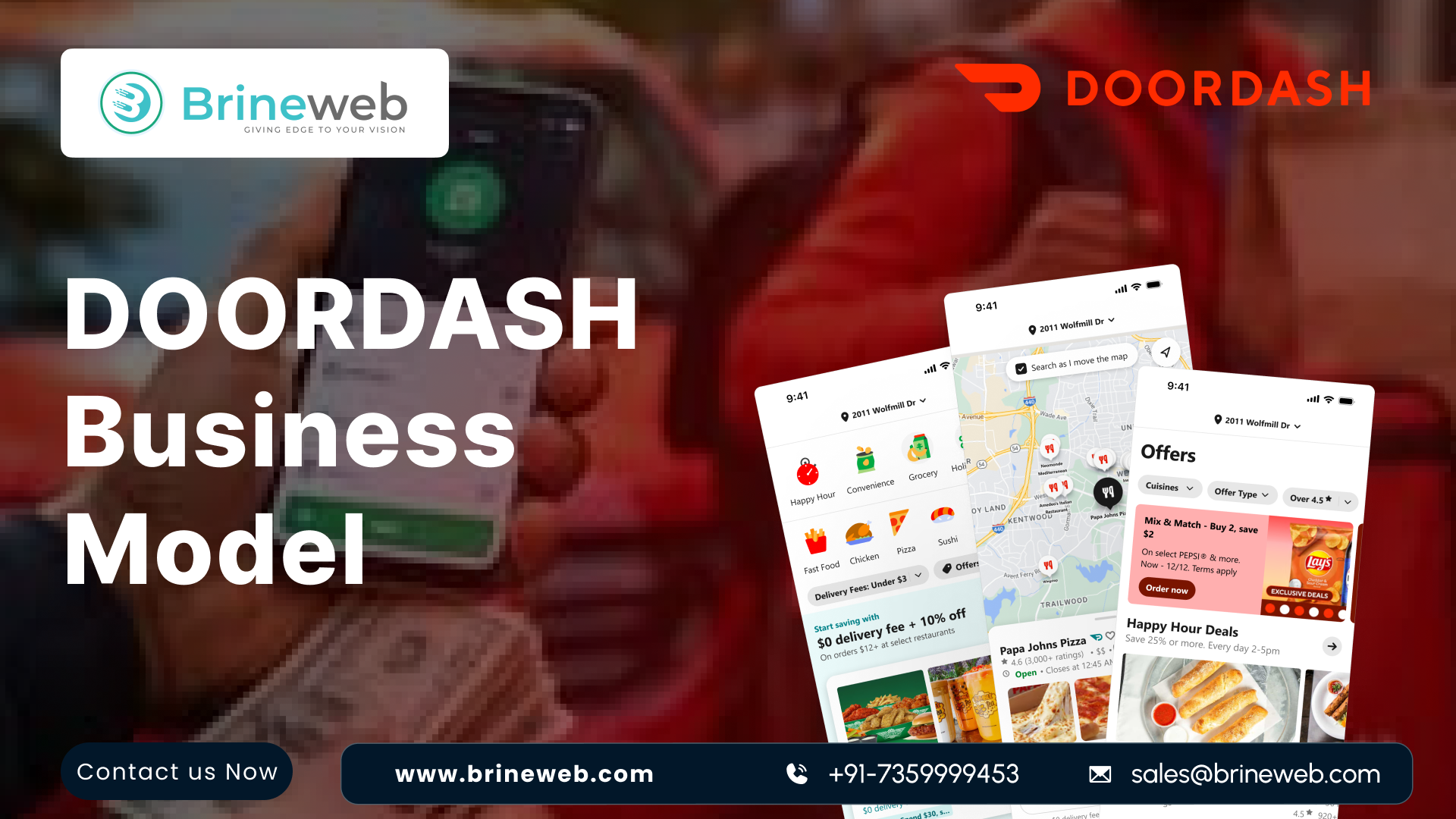
How does DoorDash make money in one sentence?
DoorDash makes money through restaurant commissions of 15 to 30% per order, customer delivery and service fees, DashPass subscription recurring revenue, in-app advertising from merchants, DoorDash Drive white-label logistics fees, and DashMart convenience store margins.
From a Stanford Dorm to a $13.7 Billion Revenue Platform
In 2013, four Stanford students, Tony Xu, Stanley Tang, Andy Fang, and Evan Moore, were doing user research in Palo Alto when they interviewed the owner of Palo Alto Macarons. The owner's biggest problem was not the product or foot traffic. It was delivery. She could not afford a dedicated driver, so she could not offer delivery at all.
The students built a simple website called PaloAltoDelivery.com, listed eight local restaurants, and within hours had more orders than they could handle themselves. Tony Xu delivered food that first night in his car.
That problem, a restaurant that wants to offer delivery but cannot afford the infrastructure to do it, is still the core customer insight behind DoorDash 12 years later. The platform exists to give every restaurant access to delivery without requiring them to hire a single driver.
What followed from that founding insight is one of the fastest revenue growth stories in the history of technology platforms. Full year 2025 revenue reached $13.717 billion, up 27.93% from $10.7 billion in 2024. In 2024, DoorDash generated its first full year of positive GAAP net income. In Q3 2025, adjusted EBITDA reached $754 million, up 41% year on year. In Q4 2025, marketplace GOV hit a record $29.7 billion for the quarter.
Compared to 2019, DoorDash's business in 2024 was more than 9 times bigger in GOV, 12 times bigger in revenue, and generating almost $2.4 billion more in free cash flow.
What Is DoorDash? The Three-Sided Marketplace
DoorDash is a three-sided marketplace connecting customers who want food, restaurants that prepare it, and Dashers who deliver it. The platform sits at the centre, handling matching, payments, routing, trust infrastructure, and all the technology that makes each transaction seamless.
For customers: access to over 37 million restaurant and retail merchant products from a single app, real-time GPS delivery tracking, transparent pricing before checkout, and the convenience of paying digitally without interacting with a driver.
For merchants: access to DoorDash's 50 million+ monthly active users globally without building delivery infrastructure. The platform handles driver recruitment, logistics, payment processing, and customer acquisition. Merchants trade margin for volume and the delivery capability they could not afford to build independently.
For Dashers: flexible earning opportunities using their own vehicle, access to a stream of delivery jobs, and the ability to work any hours they choose. In 2024, DoorDash helped generate over $18 billion in earnings for Dashers.
DoorDash commands 67% of the US food delivery market by order volume, targeting underserved suburban and secondary markets that competitors like UberEats concentrated less on, achieving lower acquisition costs and higher retention in those geographies. As of 2026 following the Deliveroo acquisition, the platform operates in over 40 countries with more than 50 million monthly active users globally.
How DoorDash Works: The Order Flow
Understanding the mechanics of a single order is the clearest way to see where revenue is captured at each step.
A customer opens the DoorDash app, browses restaurants nearby, adds items to their cart, and checks out. Before confirming, they see an itemised breakdown of the subtotal, delivery fee, service fee, and any applicable taxes. Payment is processed digitally through cards, PayPal, DashPass credits, or other supported methods.
The restaurant receives the order through its merchant dashboard or tablet. Staff accept the order, set preparation time, and begin cooking. The DoorDash algorithm simultaneously dispatches the nearest available Dasher, calculating estimated pickup time to synchronise with when food will be ready.
The Dasher receives a notification with pickup details, restaurant location, and estimated earnings. They navigate to the restaurant, confirm pickup via the app, and deliver to the customer's address with GPS routing. Real-time order tracking lets the customer follow every step from preparation to arrival.
On delivery, both customer and restaurant rate the experience. Restaurant ratings affect search visibility. Dasher ratings affect job priority and access to top-tier orders.
DoorDash captures revenue from the restaurant-side commission, the customer-side fees, and increasingly from advertising paid by restaurants that want better placement before a customer even begins browsing.
DoorDash's Revenue Model: Every Stream Explained
1. Restaurant Commission (55 to 60% of Revenue)
Commission is DoorDash's largest revenue stream. Every time a customer places an order, the restaurant pays DoorDash a percentage of the order value. Rates typically range from 15% to 30% depending on the service tier, the restaurant's chosen visibility package, and whether they use DoorDash's own drivers or their own.
DoorDash offers restaurants three commission tiers:
Basic Plan at 15% commission. Restaurants appear in search results but have limited promotional visibility. DoorDash uses its own Dashers for delivery.
Plus Plan at 25% commission. Restaurants appear higher in search, gain access to DoorDash's premium customer segment, and benefit from expanded delivery radius.
Premier Plan at 30% commission. Maximum visibility, access to all Dashers, and DoorDash's marketing and promotional tools. Premier plan restaurants also benefit from a delivery guarantee that compensates them if DoorDash cannot fulfil an order.
On 761 million total orders in Q2 2025 at an average order value of approximately $32, even a 20% average commission rate generates approximately $4.9 billion in commission revenue for that single quarter. At scale, the mathematics of commission compound into exceptional absolute numbers.
2. Customer Delivery and Service Fees (Approximately 25% of Revenue)
Every customer order includes a delivery fee and a service fee. The delivery fee runs $1 to $8 based on distance, Dasher availability, and real-time demand conditions. The service fee is a percentage of the order subtotal, typically up to 15%, covering platform operating costs.
Surge pricing automatically adjusts delivery fees during peak demand periods, bad weather, and high-traffic events. This improves Dasher earnings during difficult conditions and increases per-delivery revenue during the most valuable booking windows.
Small order fees apply when cart value falls below a minimum threshold. Priority delivery fees let customers pay extra to jump the standard queue. Both protect and improve per-order economics without requiring any additional platform investment.
3. DashPass Subscription (Approximately 10 to 12% of Revenue)
DashPass is DoorDash's monthly subscription program. Members pay a fixed monthly fee and receive free delivery on qualifying orders, reduced service fees, exclusive discounts, and priority customer support.
DashPass membership surpassed 22 million subscribers exiting 2024, up from 18 million exiting 2023. In Q2 2025, average order frequency among DashPass members reached an all-time high.
The financial impact of DashPass on the business model is significant beyond the subscription fee itself. A DashPass subscriber who has already paid for the month orders 3 to 4 times more frequently than a non-subscriber to extract value from their membership. More orders means more commission revenue, more delivery fee revenue, and more advertising impression revenue, all generated from the same subscription customer at the same acquisition cost.
Internationally, Wolt+ mirrors DashPass across European and Asian markets. DoorDash more than doubled Wolt+ members exiting Q1 2025 compared to Q1 2024, making international subscription growth one of the fastest-expanding revenue lines in the business.
4. In-App Advertising (Fastest-Growing, Highest-Margin Stream)
DoorDash's advertising revenue surpassed $1 billion annual run rate in 2025, having doubled year on year. Advertising accounts for approximately 8% of revenue but carries significantly higher margins than commission or delivery fee revenue because serving an ad costs essentially nothing once the platform infrastructure exists.
Restaurants pay for sponsored listings that place them at the top of cuisine category pages and search results. They pay for banner placements on the home screen and for featured positions in the app's discovery feed. Large chains negotiate platform-wide promotional packages. A self-serve advertising tool launched in 2025 democratised access to the advertising platform for smaller merchants who previously could not afford agency-managed campaigns.
DoorDash's advertising penetration rate sits at 1.2% of marketplace GOV compared to UberEats' 2%. That gap represents significant headroom. Closing it to parity would add hundreds of millions in high-margin advertising revenue at current marketplace volumes. Advertising is the clearest path to continued margin expansion.
The strategic parallel is direct: the same advertising flywheel that Amazon built on top of its e-commerce marketplace is what DoorDash is building on top of its delivery marketplace. Data on exactly what a user ordered last Tuesday in which neighbourhood at what time makes DoorDash's targeting precision genuinely valuable to every restaurant and FMCG brand that wants to reach local, high-intent consumers.
To understand how UberEats has built its own advertising model to similar effect, crossing $1.5 billion in annual run rate in May 2025, the structural comparison shows that advertising is becoming the defining high-margin differentiator for all mature food delivery platforms.
5. DoorDash Drive: White-Label Logistics
DoorDash Drive allows any business, not just restaurants listed on the DoorDash marketplace, to access the Dasher network for last-mile delivery from their own website or app. A grocery chain, pharmacy, or retailer can integrate DoorDash Drive via API and fulfil same-day delivery without their customers ever opening the DoorDash consumer app.
Drive is a B2B logistics product that generates fee revenue on every delivery completed for a third-party merchant. It monetises Dasher supply during off-peak food delivery windows, improving overall driver utilisation across the network. Every delivery Drive routes through the existing Dasher network is incremental revenue on infrastructure already paid for by the consumer marketplace.
This is identical in logic to how Zomato's Hyperpure earns B2B revenue from the same restaurant partners who pay commission on the consumer side. The Zomato business model applies the same principle: both sides of the merchant relationship are revenue opportunities, and the platform that captures both sides earns meaningfully more per merchant relationship than one that only captures commission.
6. DashMart
DashMart is DoorDash's own dark store concept, operated by DoorDash directly, stocking convenience items, grocery essentials, household products, and snacks for rapid delivery. DashMart earns product margin on items it sources and sells rather than commission on third-party orders.
DashMart locations are typically co-located with Dasher wait zones to minimise delivery times. By owning the inventory, DoorDash captures the full retail margin rather than only the commission. This mirrors exactly the shift Blinkit made from marketplace to inventory-led model in September 2025, where owning the inventory rather than earning commission on third-party products improved both margins and operational control.
The Numbers: DoorDash Financial Performance
The financial trajectory confirms a business that has moved decisively past the profitability question.
Full year 2025 revenue reached $13.717 billion, up 27.93% from $10.7 billion in 2024. In 2024, DoorDash generated its first full year of positive GAAP net income, a milestone that confirmed the delivery marketplace model can be structurally profitable at scale.
In Q3 2025, total orders reached 776 million, up 21% year on year. Marketplace GOV reached $25.0 billion, up 25% year on year. Revenue reached $3.4 billion, up 27%. Adjusted EBITDA reached $754 million, up 41%. GAAP net income reached $244 million, up 51%.
In Q4 2025, marketplace GOV hit a record $29.7 billion for the quarter. Full year 2025 marketplace GOV reached approximately $95 to $97 billion based on quarterly progression. Net Revenue Margin improved from 13.1% in Q1 2025 to 13.8% in Q3 2025, reflecting improving logistics efficiency and growing advertising contribution.
DoorDash added nearly twice as many US users in the first nine months of 2025 compared to the same period in 2024. Over 25% of monthly active users ordered from at least one new verticals category as of late 2024, up from 20% a year prior.
DoorDash expects to generate well over $100 billion in combined sales for merchants and earnings for Dashers in 2026.
The Growth Strategy: Three Pillars Driving 2026 and Beyond
Pillar 1: International Expansion Through Acquisitions
DoorDash acquired Wolt, the Finnish delivery platform, for approximately $8.1 billion in 2022. Wolt brought 27 countries of European and Asian operational expertise, a loyal subscriber base, and a technology stack that accelerated DoorDash's entry into markets it could not have entered organically at speed.
In May 2025, DoorDash announced the acquisition of UK-based Deliveroo for approximately $3.85 billion, extending its reach to over 40 countries and a combined population exceeding one billion. The Deliveroo acquisition gave DoorDash dominant positions in the UK, France, Belgium, Italy, Singapore, Hong Kong, and several Middle Eastern markets.
The short-term challenge is migrating Deliveroo and Wolt users onto DoorDash's core platform infrastructure without significant churn. The long-term upside is a single global platform with unified technology, unified data, and unified advertiser relationships operating across 40+ countries at massive scale.
Grab executed a comparable multi-country expansion across Southeast Asia from a single market base, using each new country's data to improve the platform's performance in every other country it operates in. DoorDash's international strategy follows the same compounding logic across a larger geographic footprint.
Pillar 2: Vertical Expansion Beyond Restaurants
DoorDash's management describes its ambition as becoming a "one-stop shop for all local commerce needs." In practice that means making grocery, convenience, pharmacy, retail, and alcohol delivery as fast and reliable as restaurant delivery.
Over 25% of DoorDash's monthly active users ordered from a new verticals category in late 2024. The grocery segment in particular is showing strong retention because grocery is a higher-frequency, higher-basket-value category than restaurant food. A customer who orders groceries twice a week through DoorDash generates more GOV than a restaurant customer who orders twice a week, because grocery baskets are typically larger.
DoorDash expanded its US marketplace by over 100,000 stores in 2024. Its product catalogue now spans over 11 million grocery and retail products. That selection breadth makes the app more useful as a daily commerce platform rather than an occasional food treat, which improves both retention and order frequency.
Pillar 3: Advertising and Technology as Margin Drivers
DoorDash's advertising revenue doubling year on year to a $1 billion annual run rate signals that the platform is successfully monetising the attention of 50 million+ monthly active users in ways that extend well beyond delivery commission.
The acquisition of Symbiosys for $175 million in 2025 accelerated the build-out of DoorDash's off-platform advertising capabilities, allowing merchants to reach DoorDash users across the open web and social media using DoorDash's purchase data for targeting. This is the same retail media model Amazon Advertising uses to serve ads beyond Amazon.com.
AI integration across search, personalisation, and operational efficiency is improving both the consumer experience and the platform's economics simultaneously. Better personalisation increases conversion. Optimised routing reduces per-delivery cost. Both improve GOV and adjusted EBITDA margin without requiring proportional increases in headcount or capital.
DoorDash vs. UberEats: The Clearest Comparison
DoorDash leads with 67% US market share. UberEats leads globally by revenue and international scale. Their competitive positioning is different enough that the comparison reveals more about strategic choices than about winner and loser.
DoorDash built its US dominance by targeting suburban and secondary markets that UberEats concentrated less on. Lower competition, lower driver acquisition costs, and higher retention from a customer base with fewer alternatives built a structural moat that is very difficult to displace even as UberEats invests more in US suburban expansion.
UberEats wins on the cross-platform ecosystem advantage. An Uber One subscriber who books rides and food delivery under a single subscription has higher switching costs than a pure DoorDash consumer. This ecosystem lock-in is harder for DoorDash to replicate without a rides business.
Both platforms are building advertising businesses as their primary path to margin expansion. UberEats crossed $1.5 billion annual run rate in May 2025. DoorDash crossed $1 billion. The platform that builds the more precise, data-rich advertising product will capture a disproportionate share of the billions in restaurant and FMCG advertising spend that is shifting from traditional media to delivery platforms.
For a deeper look at how Gojek built an advertising business on top of its food delivery platform using the same flywheel logic in Southeast Asia, the parallels with DoorDash's advertising strategy are direct and instructive.
What Makes DoorDash's Model Defensible
Suburban density is a physical moat. DoorDash's supply density in US suburban markets took years to build. Restaurants that signed on, Dashers who established routes, and customers who built habits around DoorDash in these markets are not easily disrupted by a competitor spending on marketing. Physical density compounds in ways that advertising spend cannot quickly replicate.
DashPass creates a loyal, high-frequency core. 22 million subscribers paying monthly fees generate predictable recurring revenue and order 3 to 4 times more frequently than non-subscribers. This high-frequency core is more resilient to competitive pricing pressure because their habit is locked in through both the subscription payment and the reward system that reinforces each additional order.
The advertising flywheel compounds with data. Every order DoorDash processes makes its targeting more precise for the next advertiser. More precision means higher advertising ROI for merchants. Higher ROI means more merchant advertising spend. More spend means higher advertising revenue. This data flywheel takes years to build and cannot be replicated by a competitor launching a new advertising product.
International scale from acquisitions is now operational. Wolt's European technology and team gave DoorDash operational infrastructure in 27 countries without the years of ground-up market building that organic international expansion requires. Deliveroo adds the UK, France, and several high-value markets on top of that. Combined, DoorDash's international footprint now rivals any food delivery platform globally.
Challenges DoorDash Faces
Integrating Deliveroo without churn. Migrating Deliveroo's customer base, merchant relationships, and operational infrastructure onto DoorDash's platform without losing significant users or merchant partners is the most immediate execution risk in 2026. The next 12 to 18 months are explicitly described by management as a period of elevated integration complexity.
Advertising penetration gap with UberEats. DoorDash's advertising penetration rate of 1.2% of GOV versus UberEats' 2% represents a gap that better-capitalised competitors are already closing. Accelerating advertising growth while maintaining merchant satisfaction requires a self-serve tool that is genuinely better than what competitors offer.
Regulatory pressure on gig worker classification. In California and several European markets where Wolt and Deliveroo operate, gig worker classification laws are pushing platforms toward employment models that would significantly increase per-delivery labour costs. The outcome of these legal battles across multiple jurisdictions will materially shape DoorDash's cost structure over the next three to five years.
International profitability timeline. While international markets grew faster than the US in 2025, they generate lower unit economics than the mature US marketplace. Achieving the same contribution margin improvement internationally that took DoorDash years to build domestically requires continued investment ahead of returns.
What Founders Building Food or Delivery Platforms Can Take From This
Suburban and secondary markets are where durable advantages are built. DoorDash's 67% US market share was built in markets UberEats underserved, not by winning Manhattan or San Francisco head-to-head. In every market globally, the most durable platform positions are built in the second and third-tier cities where the major platforms are present but where supply density is thin enough that a focused operator can own the experience.
Subscriptions convert occasional users into platform-dependent habits. DashPass's 3 to 4 times frequency uplift among subscribers is consistent across every platform that runs a serious subscription program. Design your subscription from day one with the specific behaviours you want to reinforce, not just as a discount mechanism.
Advertising is the margin layer that makes delivery platforms genuinely profitable. Commission revenue is structurally thin after delivery costs. Advertising has near-zero marginal cost once the platform exists. Plan your advertising product from the architecture stage even if you cannot activate it until you have 50,000 or more monthly active users.
Vertical expansion multiplies revenue from existing infrastructure. Every grocery, pharmacy, or retail delivery DoorDash routes through its Dasher network is incremental revenue on infrastructure already paid for by restaurant orders. Build your platform to support multiple delivery categories from the start, even if you launch with one.
If you are deciding how to build your platform, our food delivery app development guide covers the full technical architecture, feature set, costs, and build vs white-label decision framework. For the broader revenue model design, our taxi app revenue model guide covers how to sequence commission, subscription, advertising, and corporate revenue streams as your platform matures, principles that apply directly to food delivery economics.
Ready to Build Your Food Delivery Platform?
DoorDash grew from a Palo Alto delivery website to a $13.7 billion revenue business by solving one problem exceptionally well, giving restaurants access to delivery without requiring them to hire a single driver, and then layering advertising, subscriptions, and international scale on top of that foundation.
You do not need to replicate every layer on day one. You need a clear first market, a focused city or neighbourhood to dominate first, and a technology foundation built to support multiple revenue streams as you scale.
Brineweb's delivery app development platform gives you a production-ready foundation for food, grocery, pharmacy, and on-demand delivery. Customer app, delivery partner app, merchant dashboard, live order tracking, payment processing, and admin console, all configurable to your market and revenue model from day one.
Get a free quote from Brineweb and find out exactly what it costs to build a delivery platform designed to grow from first order to full profitability.