info@brineweb.com
 +91 73599 99453





























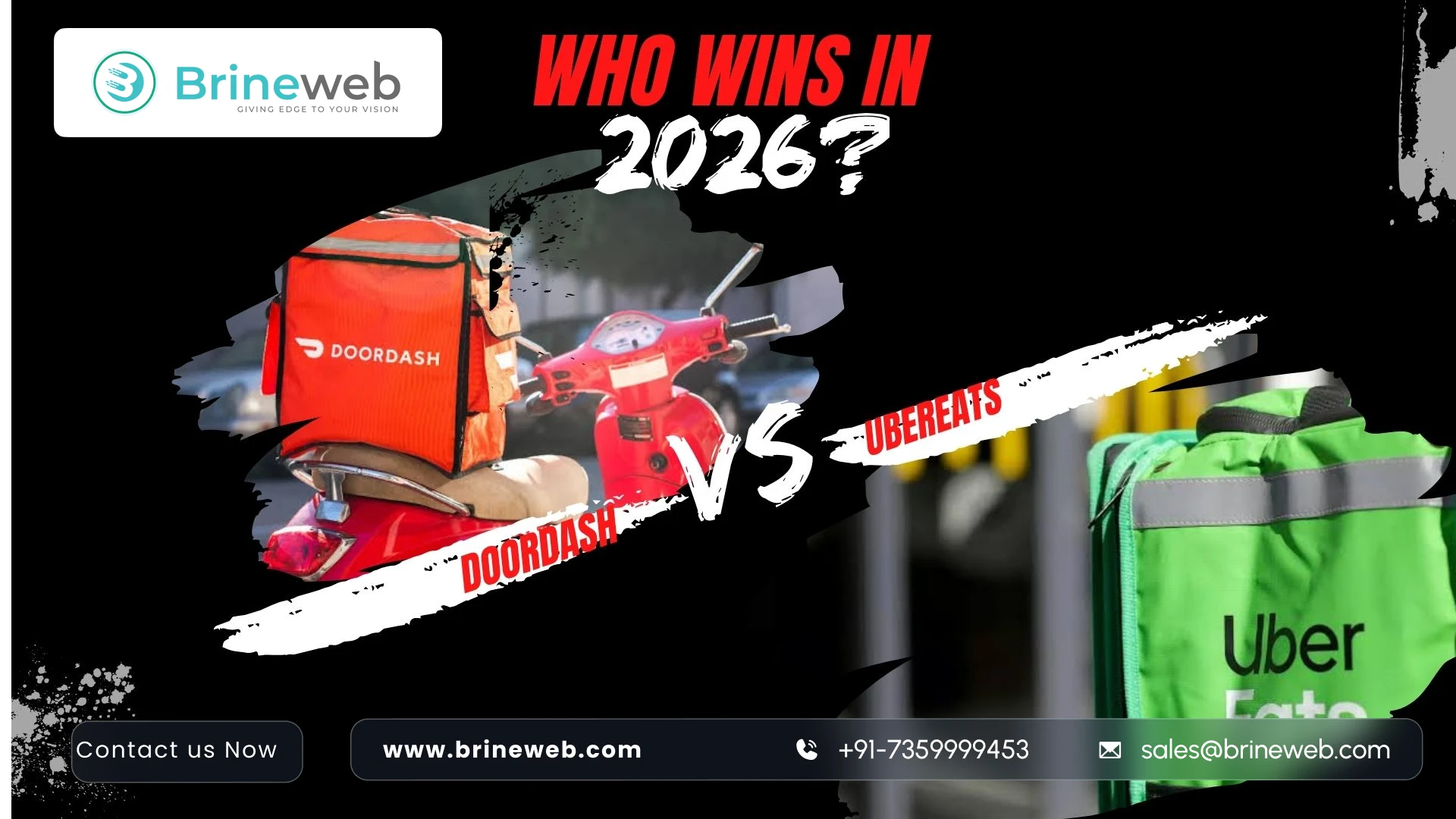
DoorDash controls 67% of the US food delivery market. UberEats leads globally across 45+ countries with $17.1 billion in 2025 revenue. DashPass has 22 million subscribers. Uber One has 46 million. DoorDash's Q4 2025 marketplace GOV was $29.7 billion. UberEats' Q4 2025 delivery gross bookings came in at $25.4 billion.
Both platforms are profitable. Both are growing. And they are competing on fundamentally different strategic axes, which is what makes the comparison actually interesting for anyone trying to understand food delivery economics in 2026.
This is the full head-to-head.
How Each Platform Was Built
DoorDash was founded in 2013 by Stanford students Tony Xu, Stanley Tang, Andy Fang, and Evan Moore. It started by building delivery infrastructure for suburban and secondary US cities that Grubhub and UberEats ignored in favour of dense urban cores. That geographic focus, going where competitors weren't, is the foundational strategic decision that explains its current 67% US market dominance.
UberEats launched in 2014 as a food delivery extension of Uber's existing ride network in Los Angeles. Its global expansion was structurally faster than DoorDash's because Uber already had driver supply, local regulatory relationships, and brand recognition in every market it entered. By the time DoorDash started thinking seriously about international markets, UberEats had already established leadership positions across Europe, Asia, Latin America, Australia, and Africa.
Two different founding strategies. Two different resulting competitive positions. DoorDash owns America. UberEats owns the rest of the world.
Market Share: The Number That Defines Each Platform
In the US, DoorDash commands approximately 67% market share as of 2026. UberEats holds approximately 23 to 25%. Grubhub, under its new Wonder ownership, retains approximately 8%.
The US market tells a clear story. DoorDash outpaced UberEats by building dense driver supply in suburban America before any competitor took those markets seriously. San Francisco shows this most starkly DoorDash holds 74% market share there. Miami shows the opposite UberEats holds 55%.
Globally, the picture reverses completely. UberEats is the undisputed leader across Japan, France, Australia, Mexico, and most of Latin America. DoorDash's international footprint, built through its $8.1 billion acquisition of Finnish platform Wolt in 2022 and the $3.85 billion Deliveroo acquisition in May 2025, is growing fast but started from zero in most non-North American markets.
For a founder deciding which market to enter, this split tells you something directly useful building a DoorDash clone in the US means competing with 67% market dominance. Building in Europe, Latin America, or Southeast Asia means the leader is UberEats, and Wolt now alongside it, not DoorDash.
Revenue and Financial Performance
DoorDash reported full-year 2025 revenue of $13.717 billion, up 27.93% from $10.7 billion in 2024. In Q3 2025, total orders reached 776 million, up 21% year on year. Marketplace GOV reached $25.0 billion in Q3, and Q4 2025 marketplace GOV hit a record $29.7 billion. DoorDash generated its first full year of positive GAAP net income in 2024 and recorded $244 million GAAP net income in Q3 2025 alone.
UberEats reported delivery segment revenue of $17.1 billion for full-year 2025, up from the prior year. In Q4 2025, UberEats delivery gross bookings came in at $25.4 billion for the quarter. The Uber One subscription now drives nearly 45% of total Uber Eats bookings globally.
UberEats earns more total revenue than DoorDash because it operates in more countries with higher combined order volumes. DoorDash earns more from the US market specifically and is improving margin faster at the operating level.
Both platforms crossed into GAAP profitability in 2024. The decade-long era of burning cash to buy market share is over for both.
Subscriptions: DashPass vs Uber One
This is where the competitive models diverge most sharply and where each platform's long-term economics are being decided.
DashPass has 22 million subscribers paying a monthly fee for free delivery on qualifying DoorDash orders, reduced service fees, and exclusive restaurant discounts. DashPass subscribers order 3 to 4 times more frequently than non-subscribers. The subscription covers DoorDash only.
Uber One has 46 million members paying a higher monthly fee for free delivery on UberEats orders, discounted Uber rides, and exclusive deals across both services. Uber One drives nearly 45% of total Uber bookings globally. Because it bundles rides and food in one subscription, the switching cost is structurally higher than DashPass. A subscriber who books rides and food delivery through one monthly plan has real financial reasons not to switch to competing platforms for either service.
Uber One's subscriber lead of 46 million versus DashPass's 22 million is the most direct evidence that UberEats' cross-platform ecosystem advantage is real. A customer who uses Uber One for both their morning commute and their dinner delivery is embedded in the Uber ecosystem in a way that a food-only subscription cannot replicate.
For founders building a subscription model into their delivery platform, our DoorDash business model guide covers exactly how DashPass drives frequency and what the subscription mechanics look like at 22 million subscribers.
Commission Rates and Restaurant Economics
Both platforms charge restaurants similar commission rates with similar tier structures.
DoorDash charges 15% for its Basic Plan, 25% for Plus Plan, and 30% for Premier Plan. Each tier delivers more visibility, expanded delivery radius, and more promotional tools. DoorDash's advertising platform crossed $1 billion annual run rate in 2025.
UberEats charges 15% to 30% depending on the service arrangement. Restaurants that opt for UberEats delivery pay more. Restaurants that use their own delivery pay less. UberEats advertising crossed $1.5 billion annual run rate in May 2025, making it the larger advertising business despite its smaller US market share.
From a restaurant's perspective, which platform to prioritise depends entirely on where their customers are. A restaurant in suburban Ohio goes where DoorDash's driver density is highest. A restaurant in Tokyo, Paris, or Sydney goes where UberEats leads. Many large restaurant chains list on both.
The advertising gap is worth noting UberEats earns more from advertising despite lower US market share because its global scale provides a far larger advertising surface. A FMCG brand wanting to reach food delivery users globally pays UberEats because DoorDash cannot provide that reach yet.
Restaurant Coverage and Selection
DoorDash partners with over 37 million merchants globally across food, grocery, and retail delivery. Its US restaurant coverage extends into suburban and secondary cities at a depth that UberEats cannot yet match.
UberEats partners with over 1 million restaurant and retail partners across 45+ countries. It has exclusive and preferred partnerships with McDonald's, Starbucks, Kroger, and Aldi that give it consistent high-volume order flow and guaranteed inventory access for grocery and retail categories.
In major US metro areas, both platforms have equivalent restaurant selection. The differentiation for DoorDash is suburban coverage. The differentiation for UberEats is the exclusive corporate partnerships that bring reliable high-frequency order flow from brands with loyal customer bases.
Delivery Speed and Operations
Both platforms report average delivery times in the 25 to 35 minute range across their core markets.
DoorDash's DeepRed Dispatch Engine uses reinforcement learning to synchronise restaurant preparation time with real-time traffic and driver proximity, keeping average delivery at approximately 30 minutes. In Q3 2025, timely delivery rates remained above 90% across its US network.
UberEats uses its Trip State Model to analyse real-time GPS and motion sensor data, dispatching drivers at the precise moment food is ready for pickup. Its integration with Uber's broader mobility network means surge demand for rides and surge demand for food delivery can be balanced across the same driver pool in markets where Uber operates both services.
The operational infrastructure is comparable. Where DoorDash has an advantage is driver density in suburban markets. Where UberEats has an advantage is multi-modal driver utilisation in markets where Uber Rides and UberEats coexist.
International: Where UberEats Has No Serious Competitor
This is the most decisive difference between the two platforms in 2026.
UberEats leads in Japan, France, Australia, and Mexico. It holds strong positions across most of Latin America, significant presence in the UK and Europe, and operates across major Asian markets. Its 2025 revenue of $17.1 billion reflects the value of this global footprint.
DoorDash entered its first non-US markets through the Wolt acquisition in 2022, covering 27 European and Asian countries. The Deliveroo acquisition in May 2025 added the UK, France, Belgium, Italy, Singapore, Hong Kong, and several Middle Eastern markets. Combined, DoorDash now serves 40+ countries.
But UberEats built these international positions over a decade with local brand recognition, local regulatory relationships, and local driver networks. DoorDash is building them through acquisition, which is faster than organic entry but comes with integration risk and brand transition complexity.
If you are building a food delivery startup in Southeast Asia, Europe, or Latin America, UberEats is the incumbent to study. If you are building in North America, DoorDash is the market shape you are competing within.
For context on how UberEats built its international position and what its global revenue model looks like, our UberEats business model guide covers the full breakdown.
Head-to-Head Comparison Table
| Metric | DoorDash | UberEats |
|---|---|---|
| US market share | 67% | 23 to 25% |
| Global presence | 40+ countries | 45+ countries |
| 2025 revenue | $13.7 billion | $17.1 billion |
| Q4 2025 GOV | $29.7 billion | $25.4 billion |
| Subscription | DashPass, 22M members | Uber One, 46M members |
| Advertising run rate | $1B+ (2025) | $1.5B+ (May 2025) |
| Restaurant partners | 37M+ merchants | 1M+ partners |
| Profitability | GAAP profit since 2024 | EBITDA profit since 2023 |
| Suburban coverage | Strongest in US | Thinner in US suburbs |
| International strength | Growing via Wolt + Deliveroo | Established leader |
What Founders Building Delivery Platforms Can Learn
Geographic focus beats geographic breadth at early stage. DoorDash's entire US dominance traces back to one decision go where competitors aren't. Suburban Ohio and suburban Texas gave it the supply density and customer loyalty it later leveraged into metro markets. Find the equivalent in your geography. The underserved secondary city will give you faster growth and lower acquisition costs than trying to out-DoorDash DoorDash in New York.
The subscription that covers more wins more. Uber One's 46 million subscribers versus DashPass's 22 million reflects a structural advantage bundling rides and food in one subscription creates higher switching costs than food alone. If your platform offers multiple services, build a single subscription that covers all of them. The subscriber who has committed to your ecosystem for two verticals is far more loyal than one committed for one.
Advertising is where delivery platforms make real margin. UberEats earns $1.5 billion from advertising. DoorDash earns $1 billion. Both numbers are growing faster than commission revenue. Plan your advertising product from your platform's architecture stage, not as a feature you add later.
Acquisitions compress international timelines but carry integration risk. DoorDash acquired Wolt and Deliveroo to build international scale fast. The risk is that acquired platforms have their own brand equity, tech stacks, and operational cultures. If you are planning multi-market expansion, study how DoorDash is managing the Deliveroo migration before deciding whether to build, partner, or acquire in new markets.
If you are ready to build a food delivery platform, our delivery app development solution covers the full technology stack customer app, delivery partner app, restaurant dashboard, live GPS tracking, payment processing, and admin console.
Which Platform Wins?
The honest answer is both, in different dimensions.
DoorDash wins the US. It will likely continue to because its suburban density moat is expensive to overcome and its advertising platform is building a compounding data advantage.
UberEats wins globally. Its 10-year head start in international markets, combined with the Uber One cross-service ecosystem advantage, makes it the dominant platform in most countries outside North America.
For restaurant owners, the right platform depends on where your customers are. For drivers, it depends on which has better density in your city. For founders, it depends on which market you are building for.
Neither platform is going away. Both are profitable. Both are growing. The real question for founders is not which platform wins but what space exists between them in your specific geography that neither is optimising for.
Ready to Build Your Own Food Delivery Platform?
DoorDash and UberEats together process billions of orders annually and still leave genuine white space in secondary cities, specific verticals, and specific geographies where neither platform has built dense supply.
Brineweb's delivery app solution gives you a production-ready platform for food, grocery, and on-demand delivery. Customer app, delivery partner app, restaurant dashboard, live GPS tracking, payment processing, and admin console, configurable for your market.
Get a free quote from Brineweb and find out what it costs to launch your delivery platform.