info@brineweb.com
 +91 73599 99453






















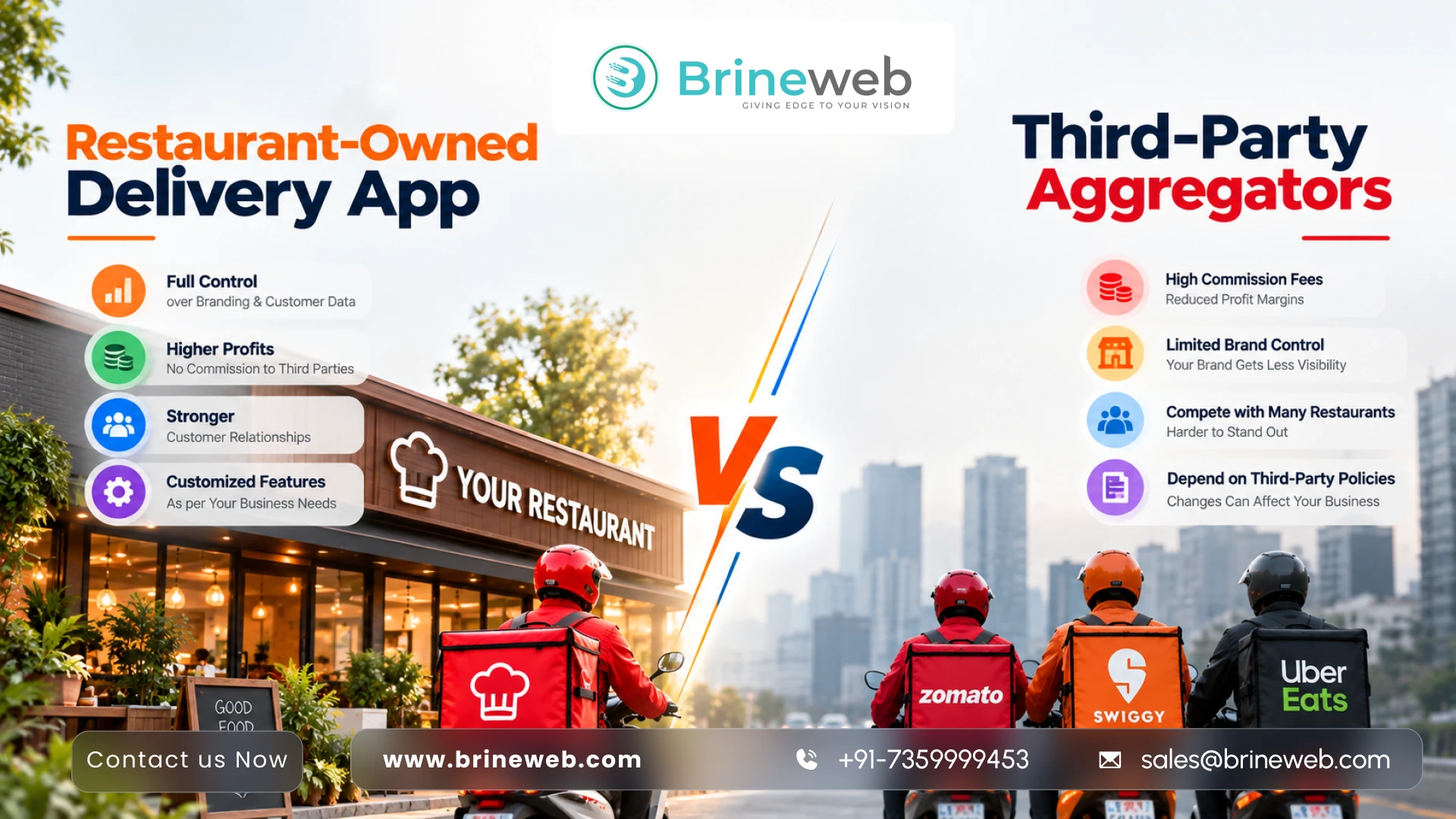
Third-party aggregators charge 15 to 30% per order forever. A restaurant-owned delivery app costs once and keeps the margin. Here is the full comparison so you can decide which model actually works for your business.
The Commission Problem Every Restaurant Knows
A restaurant doing $20,000 in monthly delivery revenue through a third-party aggregator at 30% commission pays $6,000 every month in fees. That is $72,000 per year. Not to a supplier. Not to staff. To a platform.
The math is straightforward if you run $20,000 through third-party platforms monthly at 33%, that is $6,600 per month or $79,200 annually in commissions.
For most restaurants operating on 5 to 15% net margins, that commission does not come from profit. It comes from raising menu prices on the aggregator platform, which drives customers away, or absorbing it, which eliminates the margin the delivery was supposed to generate.
The global food delivery market is expected to reach $1.54 trillion in value in 2026. The question every restaurant owner faces is not whether delivery is important. It is whether paying a permanent 15 to 30% tax on every delivery order is the right way to participate in that market.
This comparison gives you the full picture.
What Is a Third-Party Aggregator?
A third-party aggregator is a platform like DoorDash, UberEats, Zomato, Swiggy, or Talabat that lists your restaurant alongside hundreds of competitors, handles customer acquisition, payment processing, and delivery logistics, and charges a commission on every order placed through their platform.
Typical commissions range from 15% to 30% per order, depending on marketing placement, logistics support, and promotional fees related to sponsored listings.
The aggregator model delivers three things restaurants value: immediate access to a large existing user base, a complete delivery logistics solution without the restaurant needing to hire drivers, and digital ordering capability without building any technology.
The cost is the commission, the loss of customer data, and being listed alongside every competitor in your category.
For context on how DoorDash built a $13.7 billion revenue business entirely on restaurant commissions and what that means for restaurants on the other side of the relationship, our DoorDash business model guide covers every revenue stream and what restaurants actually pay.
What Is a Restaurant-Owned Delivery App?
A restaurant-owned delivery app is a branded ordering platform that belongs to the restaurant. Customers download the restaurant's own app or order through its website. The restaurant processes payments, manages delivery, and owns the customer relationship and all customer data.
The restaurant pays zero commission per order. Instead, it pays a one-time or recurring fee for the technology platform and covers its own delivery costs either through employed drivers, a contracted delivery fleet, or by integrating with a logistics API like DoorDash Drive, Uber Direct, or Stuart.
When someone orders through a first-party ordering app, restaurants save 30 to 70% on commission fees. Customers also tend to spend more.
The cost is the upfront investment in technology, the ongoing cost of customer acquisition without the aggregator's built-in traffic, and the operational complexity of managing delivery directly.
Side-by-Side Comparison
| Factor | Third-Party Aggregator | Restaurant-Owned App |
|---|---|---|
| Commission per order | 15 to 30% forever | Zero |
| Upfront cost | Zero | $5,000 to $50,000 |
| Customer data ownership | Platform owns it | Restaurant owns it |
| Brand visibility | Listed among competitors | Your brand exclusively |
| Customer acquisition | Built-in from day one | Restaurant must drive traffic |
| Loyalty program | Platform loyalty, not yours | Yours to design and own |
| Menu price control | Often inflated to cover commission | Full control |
| Delivery management | Platform handles it | Restaurant manages or contracts |
| Analytics | Limited, platform-controlled | Full, restaurant-controlled |
| Customer relationship | Platform owns the customer | Restaurant owns the customer |
The Commission Cost at Different Scales
The commission impact changes significantly depending on order volume. Here is what it actually costs at different revenue levels.
$5,000 monthly delivery revenue: At 25% commission: $1,250 per month, $15,000 per year in commissions.
$20,000 monthly delivery revenue: At 25% commission: $5,000 per month, $60,000 per year in commissions.
$50,000 monthly delivery revenue: At 25% commission: $12,500 per month, $150,000 per year in commissions.
A restaurant-owned app that costs $15,000 to build pays itself back in less than three months at $20,000 monthly delivery volume, even after accounting for ongoing hosting, payment gateway fees, and marketing costs.
While you save on commission fees with in-house delivery, you cover the costs of drivers, vehicle wear, insurance, and routing software yourself. These costs are real but they are typically far below the aggregator commission at any meaningful delivery volume.
The Customer Data Problem Nobody Talks About Enough
When a customer orders from your restaurant on DoorDash, DoorDash knows:
Their name, phone number, home address, payment method, order frequency, average order value, what cuisine they order from competitors, and their price sensitivity across hundreds of restaurants.
You know your kitchen received an order.
Managing delivery directly allows you to collect customer data including email addresses, phone numbers, and order history, rather than using a third-party aggregator. Owning this data allows you to strengthen customer relationships and encourage repeat buying.
With your own app you know everything the aggregator knows. You can send customers reorder reminders exactly when their usual ordering cycle is due. You can offer birthday discounts that feel personal rather than algorithmic. You can target your most frequent customers with subscription offers. You can identify customers who have not ordered in 30 days and win them back with a discount.
None of this is possible when a third-party platform owns the customer relationship.
Brands using direct ordering platforms have reported 30% higher repeat order rates and 28% lower delivery costs.
The customer data advantage compounds over time. Every order through your own app deepens your relationship with that customer. Every order through an aggregator deepens the aggregator's relationship with them.
Brand Control and Customer Experience
On an aggregator, your restaurant competes for visibility against every competitor in your cuisine category. Your logo appears in a grid alongside 50 other restaurants. The customer experience from the moment of search to the moment of delivery is the aggregator's experience, not yours.
Delivery errors, delays, or mishandling by third-party drivers can harm your brand. Direct ordering keeps you in control of the customer experience and branding.
A customer who orders from your own app experiences your brand from the first tap. Your design. Your loyalty program. Your communication. Your packaging instructions delivered correctly. Your driver trained to your standard. When something goes wrong, you fix it. When something goes right, the customer associates it with you.
Personalized experiences foster an emotional connection. Loyalty programs help with long-term retention. Branding is extremely important for restaurants that sell an exotic menu, specialty items, or premium-priced establishments.
For platforms like Talabat that have built deeply loyal user bases across the GCC through their own branded experience, the principle is the same: the platform that owns the customer relationship earns the loyalty. Our Talabat business model guide covers how subscription and brand loyalty compound when the platform controls the full customer experience.
When Third-Party Aggregators Actually Make Sense
This comparison is not an argument to abandon aggregators entirely. There are specific situations where aggregators are the right choice.
You are a new restaurant with zero delivery customers. Aggregators give you immediate access to an existing user base. You pay the commission in exchange for customer acquisition you cannot yet generate yourself.
You are testing a new market or city. Before investing in a delivery app for a new location, listing on an aggregator lets you validate whether delivery demand exists at that location before committing to technology and logistics.
Your average order value is low. For restaurants with average orders below $15 to $20, the commission as a percentage of order value is high but the absolute amount is small. The ROI of a dedicated app becomes less compelling at low order values.
You have no repeat customers yet. The data ownership advantage of your own app only compounds if customers return. If you have very low repeat order rates, the aggregator's built-in traffic acquisition is more valuable than the data you would own.
When Your Own App Wins Decisively
You have established delivery volume. Any restaurant doing consistent monthly delivery revenue above $10,000 through aggregators should be calculating the payback period on their own app. At $15,000 per month and 25% commission, you pay $45,000 in annual commissions. A well-built white-label app costs $10,000 to $20,000. The math makes itself.
You have high repeat customer rates. If customers order from you two or more times per month, the data and loyalty advantage of your own app creates compounding retention value. A customer on your own app's subscription plan is worth far more per year than a customer who finds you on DoorDash every time.
You are a premium or speciality restaurant. Price-sensitive customers who find you through aggregator search are not your target customer. Customers who specifically seek out your cuisine or brand need a direct relationship with you, not a marketplace search result.
You want to build a brand, not just generate orders. Restaurants that eventually franchise, expand to multiple locations, or develop product lines need a customer base that belongs to them. Building that base through a third-party platform means the asset belongs to the platform, not you.
For a deeper look at how Swiggy's own platform model compares to its marketplace relationships with restaurants, and what commission economics look like from the aggregator's side of the relationship, our Swiggy business model guide covers the full picture.
The Hybrid Model: The Approach Most Restaurants Land On
Many restaurants use aggregators for discovery and their own app for loyalty and retention. This hybrid approach is increasingly the dominant strategy in 2026.
The logic is straightforward. Use aggregators to acquire new customers who discover you through search. Once they order once, get them onto your own app through a promotion, a QR code on the packaging, or a post-order email or SMS.
The second order from your own app costs you zero commission. Every subsequent order costs zero commission. The aggregator served as a customer acquisition channel for a one-time cost. Your own app handles the lifetime value from there.
As per the National Restaurant Association's 2025 report, off-premises orders account for nearly 75% of restaurant traffic, underscoring the need for stronger mobile and digital ordering channels.
This hybrid approach mirrors what Zomato has documented across its restaurant partner base restaurants that build direct ordering channels alongside aggregator listings generate higher total revenue per customer because they capture the high-commission first order through the aggregator and the zero-commission repeat orders through their own platform.
What You Need to Build Your Own Restaurant Delivery App
A restaurant-owned ordering and delivery platform requires four components.
Customer ordering app. Branded iOS and Android app with menu browsing, customisation, cart and checkout, digital payment, order tracking, loyalty points, and push notifications.
Kitchen or order management dashboard. Real-time order receipt, preparation time management, order status updates, and integration with your POS system.
Delivery management. Either an in-house driver app for your own delivery team, integration with a third-party logistics API for on-demand driver networks, or a click-and-collect only model where customers pick up.
Admin dashboard. Menu management, pricing control, customer data and analytics, loyalty program management, promotion campaigns, and performance reporting.
Cost range: White-label branded restaurant app: $5,000 to $20,000. Launches in 3 to 6 weeks. Custom development: $30,000 to $100,000+. Takes 4 to 9 months.
For founders and restaurant groups making this technology decision, our clone app vs custom app development guide covers the full decision framework based on your volume, budget, and timeline.
The Real Numbers: Commission vs App Ownership Payback
Here is the payback calculation at three delivery volume levels.
$10,000 monthly delivery revenue: Annual commission at 25%: $30,000 App development cost: $15,000 Break-even: 6 months
$20,000 monthly delivery revenue: Annual commission at 25%: $60,000 App development cost: $15,000 Break-even: 3 months
$50,000 monthly delivery revenue: Annual commission at 25%: $150,000 App development cost: $20,000 Break-even: 6 weeks
In the long run, it is less expensive to invest in your own online ordering platform than to continue paying 30% transaction fees forever.
How AI Makes Your Own App Even More Valuable
A restaurant-owned app that uses AI delivers benefits no aggregator can match because the AI is working for you, not for the platform.
AI-powered reorder reminders sent at exactly the right moment based on each customer's ordering frequency. Personalised menu recommendations based on past orders. Dynamic promotional offers targeting specific customer segments. Demand forecasting that helps you prep the right quantity of each dish before the orders arrive.
These are the same capabilities that AI in food delivery apps builds into large platform operations, now accessible to individual restaurant brands through modern app platforms.
Ready to Build Your Own Restaurant Delivery App?
By 2026, direct online ordering will outperform aggregators in retention and ROI.
The restaurants that build their own delivery apps in 2026 are the ones that will own their customers, their data, and their margins in 2028. The ones that remain entirely dependent on aggregators will keep paying the commission indefinitely.
You don't need to abandon aggregators entirely. Use them for acquisition. Build your own app for retention.
Brineweb's delivery app development platform gives you a production-ready foundation for restaurant ordering and delivery. Customer ordering app, kitchen dashboard, delivery management, loyalty features, and admin console, all configurable for your brand and your market.
Get a free quote from Brineweb and find out what it costs to launch your own restaurant delivery app.