info@brineweb.com
 +91 73599 99453





















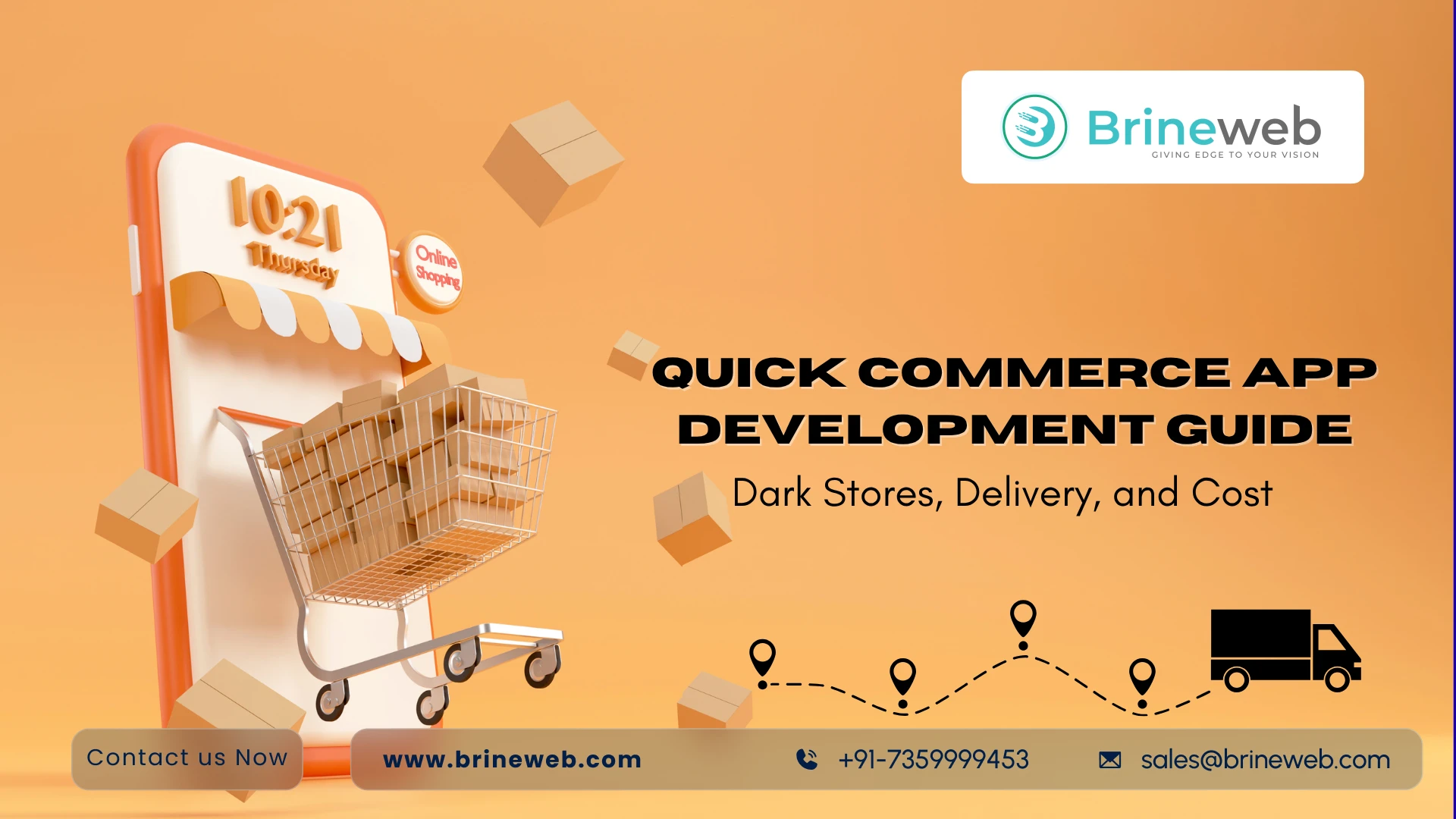
What Is Quick Commerce and Why It Is Different
Quick commerce is not faster e-commerce. It is a fundamentally different fulfilment model.
E-commerce typically ships from a central warehouse and takes anywhere from a day to a week. Quick commerce relies on small, local dark stores placed close to customers, which is what makes 10 to 30 minute delivery possible in the first place. The business model, not just the app, is built around speed.
Traditional e-commerce centralises inventory in large warehouses and ships outward. Quick commerce inverts this it pushes small amounts of fast-moving inventory to dozens of neighbourhood-level micro-fulfilment centres called dark stores, each serving a 2 to 3 kilometre radius, so that when an order arrives, the item is already 5 minutes from the customer's door.
That architectural difference is why you cannot build a quick commerce app on a Shopify plugin or a standard grocery marketplace platform. Real-time inventory decrement per dark store, picker workflow management, zone-based order routing, and sub-minute dispatch decisions require purpose-built infrastructure.
Quick commerce is a rapidly growing market driven by consumer demand for ultra-fast delivery and seamless convenience, projected to reach 900 million users by 2029.
The platforms that have proven this model in India, including Blinkit, Zepto, and Swiggy Instamart, collectively deliver tens of millions of orders per month. Blinkit is EBITDA positive at over 2,100 dark stores. For a complete understanding of how Blinkit's dark store model achieves 10-minute delivery economics at scale, our Blinkit business model guide covers the full operational picture.
What Is a Dark Store?
A dark store is a small retail-format warehouse, typically 1,500 to 5,000 square feet, located in a dense residential or commercial area, stocked with 2,000 to 10,000 fast-moving SKUs, and operated exclusively for online order fulfilment. No customer-facing retail. No walk-in shopping. Only picking and packing for delivery.
Dark stores are positioned within 2 to 3 kilometres of their target delivery radius. This proximity is what makes 10 to 30 minute delivery achievable. A customer 1.5 kilometres from the nearest dark store can receive an order in the time it takes a picker to find the items, pack them, and hand them to a waiting delivery partner.
The operational decisions that determine whether a dark store is profitable are:
Order density. The industry breakeven sits at approximately 1,200 to 1,400 orders per day per dark store at an average order value of around ₹600 to $15. Below this threshold, fixed costs (rent, staff, inventory holding) exceed the contribution per order. Above it, the store generates positive contribution margin.
SKU selection. Not every product belongs in a dark store. The right 2,000 to 5,000 SKUs are the ones with the highest purchase frequency and the lowest perishability risk. Chips, packaged goods, dairy, and household essentials. Not long-tail specialty items or slow-moving products that sit in the store and expire.
Pick-path optimisation. A picker who walks an inefficient path through the warehouse to collect a 5-item order adds 2 to 3 minutes per order. At 1,000 orders per day, that is 2,000 to 3,000 wasted picker-minutes. Organised warehouse layout and AI-optimised pick-paths directly improve both speed and labour cost.
Zepto's approach to dark store expansion, covering 1,139 dark stores across 66 cities in FY26 with over 60% of mature stores EBITDA positive, demonstrates exactly how dark store economics improve with density. Our Zepto business model guide covers how Zepto's inventory-led model earns better margins than a marketplace approach and why dark store profitability is the primary metric every q-commerce operator should track.
The Four Apps You Are Actually Building
Quick commerce app development requires three separate apps: customer app, picker and packer app for dark store workers, and a delivery partner app, plus a back-office management platform.
Most founders think about the customer app and forget the other three. All four are mandatory. A quick commerce platform with a polished customer app and a broken picker workflow delivers every order late.
App 1: Customer App
The customer-facing product. Browse a product catalogue filtered by what is in stock at the nearest dark store in real time. Search by product name, brand, or category. Add to cart, see the total with delivery fee and any applicable offers, and checkout in under 60 seconds.
Real-time order tracking from the moment of placement: order received, picker assigned, picking in progress, packed and ready, rider assigned, rider en route with live GPS map. Push notifications at each stage. OTP confirmation on delivery. Post-delivery rating.
The substitution flow is critical and often poorly implemented. When an item is out of stock at the moment of picking, the customer needs to approve or reject a substitute quickly or the order holds at the dark store. Build this as a real-time in-app prompt, not an email, not a delayed notification.
App 2: Dark Store Picker App
The operational engine. Pickers receive order assignments on their tablet or handheld device with a pick-list optimised for warehouse layout, showing items in the most efficient collection sequence. Barcode scanning confirms each item is correctly picked. Weight verification for items sold by weight. Substitution request flow when an item is out of stock.
The picker app is where order accuracy and speed are won or lost. A picker who has to navigate a confusing interface or lacks barcode confirmation capability will make errors that generate refunds, customer complaints, and operational overhead. The picker app must be intuitive for warehouse staff with varying technical comfort levels.
App 3: Delivery Partner App
Job alerts with pickup dark store location, order details, and customer delivery address. Accept or decline within a timer. GPS navigation to the dark store and then to the customer address with real-time route optimisation. OTP verification or photo confirmation at delivery. Earnings dashboard. Shift management.
Delivery partners in quick commerce typically operate within very tight geographic zones, often a 2 to 3 kilometre radius from a specific dark store. The delivery app must handle zone-based job allocation and prevent partners from accepting jobs outside their assigned zone during peak hours.
App 4: Admin and Operations Dashboard
Real-time monitoring of every dark store, every active order, every delivery partner, and every inventory level simultaneously. Pricing and promotion management. Inventory replenishment alerts and purchase order generation. Dark store performance analytics covering order density, average pick time, delivery SLA compliance, and wastage by SKU. Customer support queue management. Corporate account management if applicable.
The admin dashboard also manages dark store expansion: new store activation, zone boundary configuration, SKU catalogue setup for new locations, and delivery partner onboarding by zone.
Swiggy's operational challenge in managing 1,100+ Instamart dark stores simultaneously across multiple cities shows the complexity that admin infrastructure must handle at scale. Our Swiggy business model guide covers how Swiggy's platform manages the operational complexity of multi-dark-store operations including the separate subsidiary structure for Instamart.
AI Features That Separate Winners From Also-Rans
Advanced features that matter most for competitive quick commerce apps are: AI-powered route optimisation with live ETA recalculation, demand forecasting at the dark store level to prevent stockouts and reduce waste, dark store management software with pick-path optimisation, multi-channel push notifications with behavioural personalisation, dynamic pricing with surge logic for peak hours, in-app advertising infrastructure for brand placement revenue, and subscription plan management for loyalty programs.
Not all of these are day-one requirements. Here is which AI features matter most and when to build them.
Demand forecasting (build first). The most important AI feature in a dark store operation. Predicts what products will sell at what volumes in each specific dark store location by day, hour, and weather condition. Prevents both overstocking perishables that expire and understocking fast-movers that generate out-of-stock customer complaints. Every percentage point of wastage reduction in a dark store translates directly to contribution margin improvement.
Pick-path optimisation (build first). An algorithm that sequences each picker's item collection order based on warehouse layout to minimise walking distance per order. Saves 1 to 3 minutes per order on average. At 1,000 orders per day, that is 2 to 3 hours of saved picker time that either serves more orders or reduces labour cost.
AI route optimisation (build first). Calculates the optimal delivery route for each delivery partner in real time, factoring in current traffic, order weight, delivery sequence, and zone boundaries. Reduces average delivery time and fuel cost simultaneously.
Personalised catalogue and recommendations (build in month 6 to 12). Surfaces the products most likely to be relevant to each specific customer based on purchase history, time of day, and location. Increases average order value and reduces time to checkout.
Substitution intelligence (build in month 6 to 12). When an item is out of stock, AI suggests the most likely acceptable substitute based on the customer's purchase history and the out-of-stock item's attributes. Higher substitution acceptance rates directly protect order value.
For a detailed breakdown of how AI demand forecasting and route optimisation work in practice across real quick commerce deployments, our AI in grocery delivery guide covers every AI application with measured performance outcomes from deployed platforms.
Inventory Management: The Operational Foundation
Inventory management in a quick commerce dark store is categorically more complex than in a standard e-commerce warehouse.
Every order must decrement stock in real time from the specific dark store inventory, not from a shared catalogue count. A product showing as available must be available in the specific dark store that will fulfil the order, not in another dark store across town.
Minimum viable inventory management for a dark store includes real-time stock count per SKU per dark store, automatic deduction on order confirmation, low-stock alerts that trigger replenishment orders before the item stockouts, expiry date tracking for perishables with automated markdown or removal workflows, and receiving workflows when new stock arrives.
Advanced inventory management adds AI demand forecasting for automated replenishment quantity calculation, inter-dark-store transfer management for balancing stock across locations, and supplier API integration for automated purchase order generation.
CSV import and threshold-based reorder notifications are the minimum catalogue management layer for any dark store running over 100 SKUs.
The last-mile logistics AI layer that optimises rider dispatch and route calculation is distinct from dark store inventory management but equally critical. Our AI in last-mile delivery guide covers how route optimisation and dispatch AI reduce per-delivery cost by 25% and increase on-time delivery from 78% to 92%.
Tech Stack for a Q-Commerce App in 2026
The most cost-effective and performance-proven stack for q-commerce development uses React Native or Flutter for mobile apps, Node.js or Python for the backend, PostgreSQL or MongoDB for the database layer, Google Maps API for real-time tracking, and AWS or Google Cloud for infrastructure.
Frontend (all four apps): Flutter or React Native. Cross-platform development from a single codebase reduces total mobile development cost by 30 to 50%. The customer app, picker app, and delivery partner app can all be built on the same Flutter codebase with role-based feature separation.
Backend: Node.js with NestJS for a microservice architecture. Separate services for order management, inventory, dispatch, payments, and notifications so each can scale independently during peak demand.
Database: PostgreSQL for all transactional data including orders, inventory levels, and customer records. Redis for real-time caching of dark store stock counts, delivery partner locations, and active order states. At peak order volumes, the real-time inventory decrement must happen in milliseconds. Redis handles this where PostgreSQL alone would not.
Real-time layer: Socket.io for live order status updates, delivery partner location sharing, and picker status notifications.
Maps and routing: Google Maps Platform for geocoding, route optimisation, dark store zone boundary management, and delivery partner tracking. Budget $2,000 to $6,000 per month for mapping APIs at moderate scale of 5,000 to 15,000 orders per day across multiple dark stores.
AI and ML: Google OR-Tools or Routific for route optimisation. AWS Personalize for product recommendations. Prophet or custom model for inventory demand forecasting.
Cloud: AWS or Google Cloud with auto-scaling configured to handle morning, evening, and weekend demand spikes without manual intervention.
Cost Breakdown by Build Tier
Quick commerce app development cost ranges from $30,000 for a basic MVP to $350,000+ for a full-scale platform with AI and dark store management.
| Build Tier | What You Get | Cost | Timeline |
|---|---|---|---|
| MVP (1 dark store) | Customer app, basic inventory, order management, rider assignment | $19,000 to $60,000 | 12 to 18 weeks |
| Mid-level (multi-dark-store) | All four apps, multi-location inventory, analytics, substitutions | $60,000 to $140,000 | 16 to 28 weeks |
| Enterprise (3+ dark stores + AI) | Demand forecasting, warehouse automation, supplier API, promotions engine | $140,000 to $350,000+ | 22 to 40 weeks |
Component cost breakdown for a mid-level platform:
| Component | % of Total |
|---|---|
| Customer app (iOS + Android) | 20 to 25% |
| Picker app | 12 to 15% |
| Delivery partner app | 12 to 15% |
| Backend and APIs | 20 to 25% |
| Admin and operations dashboard | 12 to 15% |
| AI features (demand forecasting, route optimisation) | 10 to 15% |
| QA and testing | 5 to 8% |
Team location impact: South Asian development teams: $25 to $60 per hour. Eastern Europe: $50 to $80 per hour. US and Western Europe: $100 to $200 per hour.
Post-launch recurring costs at 5 dark stores, 3,000 orders per day: Cloud infrastructure: $3,000 to $8,000 per month. Maps API: $2,000 to $6,000 per month. Payment gateway: 1.5 to 2.9% per transaction. AI and ML inference costs: $500 to $2,000 per month.
For a full breakdown of how these costs compare across the full food and grocery delivery app category, our food delivery app development cost guide covers every component in detail with the same cost structure applied to food delivery platforms.
Revenue Model for a Quick Commerce Platform
Revenue streams typically include merchant commissions, delivery fees, advertising or sponsored product placements, and subscription plans for loyal customers.
Product margins (first-party inventory model). The primary revenue stream for platforms like Blinkit and Zepto that own their inventory. Earn 2 to 40% product margin depending on category and whether the product is a national brand or a private-label own-brand item. Private-label margins run 30 to 40%.
Delivery fees. Per-order delivery charge, dynamically adjusted by distance, order value, and demand. Free delivery thresholds above a minimum basket size to encourage larger orders.
In-app advertising (ATOM-style). Sponsored product placement at the top of search results and category pages. FMCG brands pay for visibility in front of high-intent grocery shoppers. Zepto's advertising revenue grew from ₹49 crore in FY24 to ₹1,636 crore in FY26, making it one of the fastest-growing revenue lines in quick commerce.
Subscription plans. Monthly memberships with free delivery, exclusive discounts, and priority service. Converts high-frequency customers into recurring revenue.
Corporate and B2B accounts. Offices, hotels, and property managers who order in volume through a corporate portal with consolidated billing.
Brineweb's delivery app development platform gives you a production-ready foundation for grocery, quick commerce, and on-demand delivery with all of these revenue streams configurable from launch.
Build Custom or White-Label?
Custom builds make sense only when you need deeply proprietary AI systems or are operating at scale from day one. For most entrepreneurs entering the market in 2026, a configured white-label solution is the optimal starting point.
White-label quick commerce platform: $15,000 to $50,000. Launches in 4 to 8 weeks. All four apps configured for your brand, your dark store locations, and your payment gateways. AI features available as configurable modules. Start with one dark store, validate order density, expand.
Custom development: $60,000 to $350,000+. Takes 4 to 10 months. Full control over every algorithm, every feature, every future direction. Justified when your dark store count exceeds 5 to 10 locations and proprietary AI gives you measurable operational advantage.
The right answer for most founders entering quick commerce in 2026 is white-label first, custom second. Prove your market. Prove your dark store economics. Build custom features only when your order volume tells you specifically which features create the most value in your specific market.
Our clone app vs custom app development guide gives you the full decision framework based on your stage, budget, and differentiation requirements.
Common Mistakes to Avoid
Launching with too many SKUs before proving demand. Start with 500 to 1,000 high-velocity SKUs per dark store. Prove which products sell before expanding the catalogue. Every additional SKU increases inventory holding cost, waste risk, and picker complexity without guaranteed revenue.
Opening multiple dark stores before proving one. A single dark store that reaches 1,200+ daily orders and positive contribution margin is the proof of concept that justifies the next location. Expanding to three stores before the first one works creates three simultaneous problems instead of one solvable one.
Building real-time inventory without Redis. PostgreSQL alone cannot handle sub-second stock decrements at high order volumes. Any developer building quick commerce inventory on a standard relational database without a caching layer is creating a technical debt problem that surfaces at exactly the wrong moment, during a peak demand spike.
Ignoring the picker app. The picker app is as important as the customer app. A slow, confusing, or error-prone picker workflow creates late orders, wrong orders, and customer complaints regardless of how polished the customer experience is on the front end.
Ready to Build Your Quick Commerce Platform?
The quick commerce market is growing toward 900 million users by 2029. Blinkit is profitable. Zepto's dark stores are increasingly unit-positive. The model works. The technology to build it is accessible. The market gap outside India and a few European markets is still very wide.
You do not need 1,000 dark stores and $2 billion in funding to build a viable quick commerce business. You need one well-located dark store, a thoughtfully selected initial SKU catalogue, all four apps working reliably, and enough daily order volume to prove the economics before expanding.
Brineweb's delivery app development platform gives you a production-ready foundation for quick commerce, grocery, and on-demand delivery. Customer app, picker app, delivery partner app, dark store dashboard, live order tracking, payment processing, and admin console, all configurable for your market.
Get a free quote from Brineweb and find out what it costs to launch your quick commerce platform.