info@brineweb.com
 +91 73599 99453



























Find the right food delivery app development company for 2027 with this comparison of 10 providers covering launch speed, pricing, and the features that matter.
Picking a development partner decides how fast you launch and how much you spend fixing mistakes later. Every agency says it builds scalable delivery apps. This list helps you tell them apart.
The Market Going Into 2027
Mobile apps now drive most food delivery orders. Projections vary by source and by how each one counts the market, but one estimate puts it at $1.65 trillion by 2027. Platforms keep adding grocery, pharmacy, and retail on top of restaurant orders, so your developer needs to build for expansion.
See how Zomato grew from food delivery into a multi vertical group in our Zomato business model guide.
What You Are Actually Buying
A food delivery platform is three apps and an engine. You need a customer app, a restaurant app, and a driver app. Behind them runs a real time system for dispatch, tracking, and payments.
Many agencies ship a polished customer app and underbuild the dispatch engine. Judge every company on all three apps and on how the engine behaves at dinner rush.
Want the full build breakdown? Read our food delivery app development guide.
How to Compare Companies
Use this checklist on every shortlist.
- A live delivery app in production, not a demo
- Proof that dispatch and tracking hold up under peak load
- Source code and ownership terms in writing
- A clear price, with extras listed separately
- Support and scaling help after launch
- Experience with payments and rules in your market
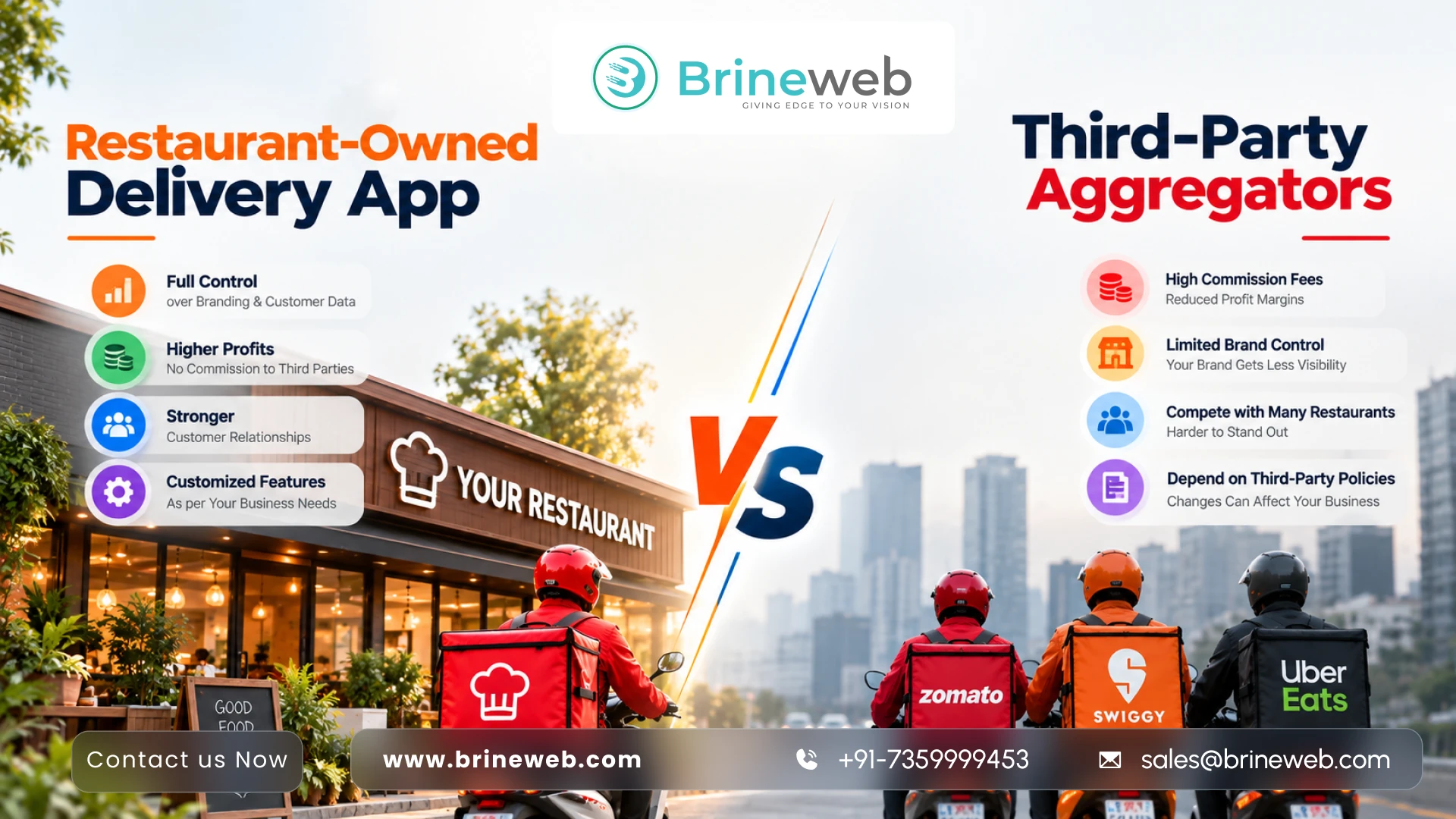
Not sure whether you need a ready platform or a ground up build? Read our custom vs white label food delivery app guide.
1. Brineweb (Best for a Launch Ready Platform With Full Configuration)
Best for: Founders, restaurant groups, and operators who need a production ready delivery platform fast, without a long custom build.
Brineweb is an on demand app development company based in Gondal, Gujarat, India. Its food delivery app is part of the Brine Go delivery family, which also covers grocery, pharmacy, multi service, and daily delivery. You get a customer app, delivery partner app, restaurant dashboard, live order tracking, payment processing, and an admin console, all configured to your brand, your market, and your payment gateways.
The same team also builds taxi and home services platforms. That lets you add services on one foundation later instead of switching vendors.
Key features: Customer app, delivery partner app, restaurant dashboard, live GPS tracking, payment integration, admin analytics, multi language support, configurable commission and delivery zones.
Launch timeline: 4 to 8 weeks.
Best markets: GCC, India, Southeast Asia, Africa, Latin America, UK, US.
Get a free quote from Brineweb and find out what it costs to launch your food delivery platform.
2. Apptunix (Best for a Productized Marketplace Base)
Best for: Businesses that want a ready starting point at offshore rates.
Apptunix is an on demand development firm based in Mohali, India. Its public pages show food, grocery, and pickup delivery solutions built as customer, merchant, and driver apps with dispatch between them. Starting from a packaged base can shorten the build, so ask exactly what is templated and what is built for you.
Key features: Customer, merchant, and driver apps, food and grocery delivery, pickup and delivery options, dispatch.
Check before you sign: Source code terms and what the base price includes. Pricing is not published.
3. Code Brew Labs (Best for Full Marketplace Builds)
Best for: Teams building a three sided food or grocery marketplace.
Code Brew Labs is headquartered in Dubai with offices in the US and UK. It positions itself around UberEats and DoorDash style delivery marketplaces. One third party summary of Clutch data puts its rates at $25 to $49 an hour with a project minimum near $10,000.
Key features: Multi sided marketplace builds, food and grocery delivery, custom dispatch.
Check before you sign: Ask for live delivery apps and client references.
4. Space-O Technologies (Best for Cost Conscious Multi Category Builds)
Best for: Teams that want one offshore partner across food, grocery, and courier delivery.
Space-O Technologies is based in Ahmedabad, India. It builds food, grocery, courier, and multi service delivery apps at offshore rates. It names Glovo among its on demand work, but that claim comes from the company, so verify it.
Key features: Food, grocery, and courier delivery, multi service apps, custom builds.
Check before you sign: Plan for the time zone gap and confirm real time dispatch experience.
5. Elluminati (Best for Operators Planning to Add More Services)
Best for: Businesses that may expand into taxi, grocery, or home services later.
Elluminati sells ready made on demand platforms across several service types, food delivery included, and publishes plenty of buyer guides. It suits operators who expect to add services as they grow.
Key features: Ready made platform modules, multi service support, admin dashboard.
Check before you sign: Confirm which modules ship in the base product and which cost extra.
6. iCoderz Solutions (Best for Comparing White Label and Custom)
Best for: Startups weighing a white label platform against a custom build.
iCoderz Solutions offers white label and custom food delivery builds and publishes detailed comparison guides for buyers. Its own 2027 list ranks itself first, so weigh it like any vendor written ranking.
Key features: White label food delivery apps, custom development, buyer guides.
Check before you sign: Get references and the exact feature list for each package.
7. Mobisoft Infotech (Best for a Custom Build With a US Based Team)
Best for: Teams that want custom development with a partner based in the US.
Mobisoft Infotech is based in Houston and runs a dedicated custom delivery practice. It builds customer, merchant, and driver apps plus the dispatch layer as custom work.
Key features: Custom customer, merchant, and driver apps, dispatch layer, integrations.
Check before you sign: Expect US pricing and ask how dispatch behaves under peak load.
8. RaftLabs (Best for Retention Features and Product Ownership)
Best for: Restaurant groups and startups that want one team to own the build and repeat order features.
RaftLabs is a product development firm founded in 2015 with offices in Dublin and Ahmedabad. It builds on demand consumer apps with live tracking, payments, and retention features. It states rates of $29 to $49 an hour and a 4.9 rating on Clutch, both self reported.
Key features: Live order tracking, payments, repeat order features, on demand consumer apps.
Check before you sign: For a very large marketplace, confirm the team can staff a heavy dispatch engine.
9. Utility (Best for Restaurant Brand Ordering Apps)
Best for: Restaurant brands that want a polished first party ordering app.
Utility is a mobile product agency in New York. According to its own portfolio, it has built ordering apps for restaurant and retail brands including Shake Shack and Wingstop.
Key features: Branded ordering apps, mobile commerce, loyalty and rewards.
Check before you sign: Its strength is brand ordering, not open network driver dispatch, and US agency pricing applies.
10. Konrad (Best for Enterprise Brand Ordering and Loyalty)
Best for: Large brands that need ordering and loyalty at national scale.
Konrad is a product and innovation firm headquartered in Toronto. It has built mobile ordering and loyalty experiences for large consumer brands, including McDonald's Canada.
Key features: Enterprise mobile ordering, loyalty programs, large scale product design.
Check before you sign: It does not publish rates, so expect premium pricing and confirm dispatch depth for marketplace builds.
How Much Does a Food Delivery App Cost in 2027?
White label platforms cost significantly less than custom development.
White label configuration: $5,000 to $80,000 depending on features, localisation, and payment gateway integration. Launches in 2 to 8 weeks.
Custom development from scratch: $20,000 to $300,000+ depending on feature scope, team location, and technology stack. Launches in 6 to 14 months.
Hourly rates: Teams in South Asia charge about $25 to $60 an hour. US and Western Europe teams charge $100 to $200.
For most founders in 2027, white label is the right starting point. Prove your market with real orders. Invest in custom development once your order data shows what your market needs.
Get the full line by line breakdown in our food delivery app development cost guide.
Questions to Ask Before You Sign
Ask every company how it assigns drivers in real time. Ask what happens when you reach 10,000 orders a day. Ask who owns the customer data and the code. Ask which AI features come in the base price.
See what AI adds to dispatch and demand planning in our AI in grocery delivery guide.
Red Flags
Walk away when a company has no live app to show. Walk away when scope is vague or ownership terms are unclear. Be careful with fixed prices that have no change process, hidden per order fees, and no support after launch.
Still weighing a ready platform against a ground up build? Read our clone app vs custom app development guide.
Plan Your Revenue Model First
Every developer will ask how you plan to earn. Decide on commission, delivery fees, subscriptions, and advertising before you brief anyone. Your model shapes the features you pay for.
See how DoorDash combines these streams in our DoorDash business model guide.
A Lesson From GrubHub
GrubHub sold for $650 million in January 2025 after Just Eat paid $7.3 billion for it in 2021. Features did not protect it. Restaurant supply, density, and logistics decide who wins. Hire the partner that supports your market plan, not the one with the longest feature list.
Learn what went wrong and right in our GrubHub business model guide.
Ready to Launch Your Food Delivery App?
The right food delivery partner gets you to market in weeks rather than months, with a platform your customers trust, your drivers find easy to use, and your team can manage without calling a developer every time you change a fee.
Brineweb's Brine Go delivery platform is built for exactly this. Customer app, delivery partner app, restaurant dashboard, live tracking, payments, and admin console, configured for your market, your brand, and your revenue model.
Get a free quote from Brineweb and find out what it costs to launch your platform.