info@brineweb.com
 +91 73599 99453





























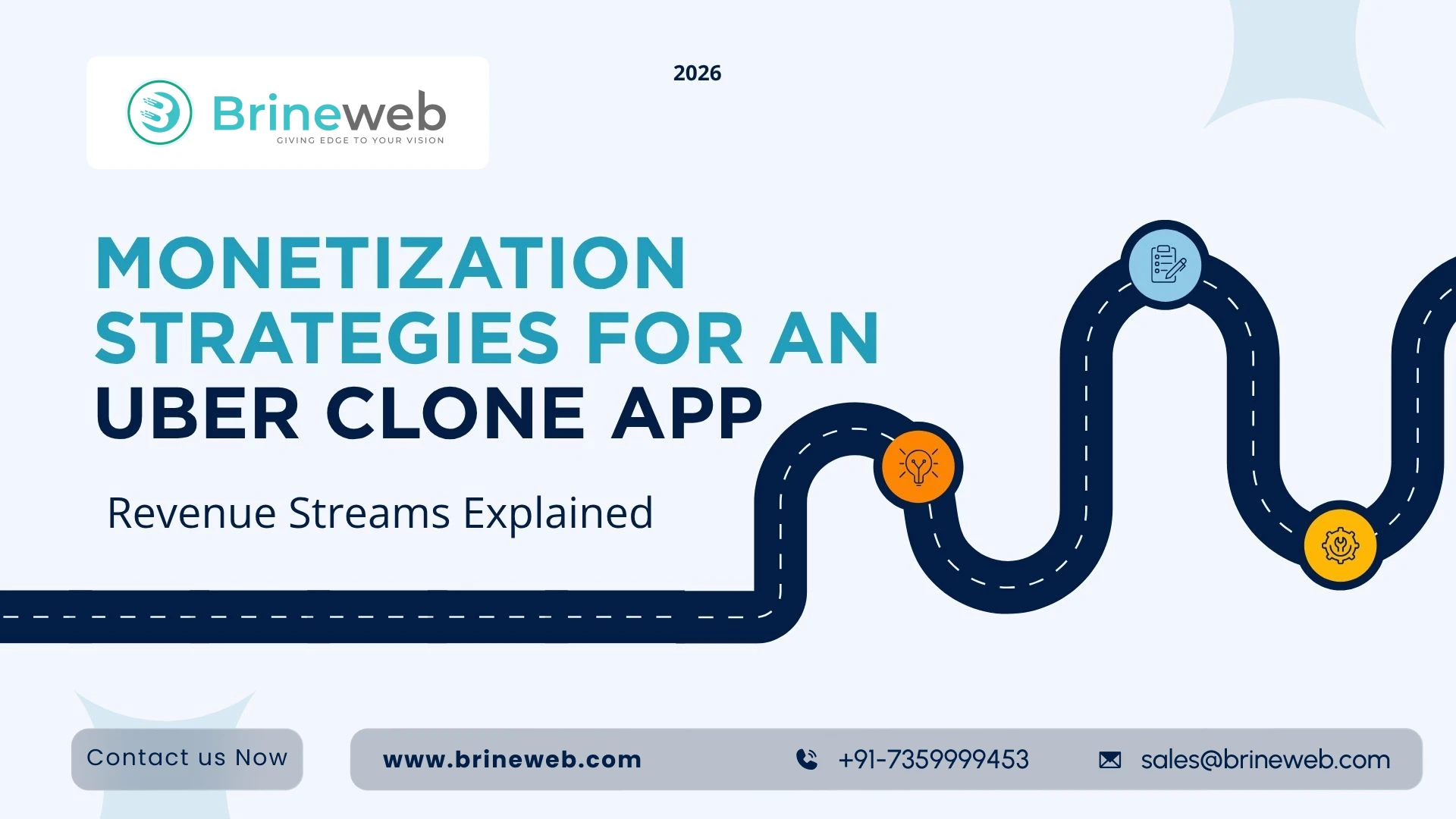
Commission alone is not enough. The most profitable Uber clone operators in 2026 combine 8 to 10 revenue streams on the same platform. Here is every stream explained, with real numbers and the right sequence to activate each one.
Why Commission Alone Is Not a Business Model
Commission per ride remains the top revenue source at approximately 48% of total revenue for ride-hailing platforms. That means 52% of revenue comes from everything else.
The ride-hailing platforms that reached profitability, Uber, Grab, Bolt, and Cabify, all did it by stacking revenue streams on top of the commission base. Platforms that stayed commission-only are either still loss-making or have already exited markets where they could not sustain the unit economics.
A well-monetised Uber clone in a mid-tier city can generate $30,000 to $200,000 per month in gross commissions within 18 months. The ceiling on that number is raised significantly by every additional revenue stream you activate on the same platform infrastructure.
Here are the 10 monetisation strategies that work for an Uber clone app in 2026, in the sequence that makes the most sense to activate them.
Revenue Stream 1: Commission Per Ride
The foundation of every ride-hailing platform. When a passenger books a ride and the driver completes it, the platform retains a percentage of the total fare.
Uber charges 15 to 30% of the ride fare depending on the service type and location. This model ensures a continuous revenue flow as the app scales.
Set your commission rate based on your competitive environment. In markets where Uber or Bolt are active at 25% commission, launching at 15% builds driver supply faster. In markets where you are the first digital platform, 20% is immediately viable.
The commission model scales naturally. More rides mean more revenue with no proportional cost increase. Every driver you onboard and every passenger who books generates commission without requiring any additional platform investment.
Commissions remain the top source at 48% of total revenue, followed by subscriptions at 18%.
The driver subscription model is an alternative to per-ride commission that builds stronger driver loyalty. Rather than taking a percentage of every fare, charge drivers a flat daily or weekly platform access fee and let them keep 100% of every fare above that cost. Our Rapido business model guide covers exactly how Rapido scaled to millions of rides using the subscription model instead of commission, and why it produces better driver retention than percentage-based commission.
Revenue Stream 2: Surge Pricing and Dynamic Pricing
Surge pricing automatically increases fares when demand exceeds supply. Peak hours, bad weather, major events, and holidays all generate legitimate surge conditions where passengers will pay more and drivers need financial incentive to go online.
Surge pricing maximises revenue when demand exceeds supply. This strategy helps companies generate 5 to 8% net revenue gain purely from dynamic adjustments.
Configure surge pricing rules in your admin dashboard: trigger thresholds by zone and time, maximum surge multipliers, customer communication requirements, and driver earnings uplift during surge periods.
The key to surge pricing that does not alienate customers is transparency. Show the surge factor before the customer confirms the booking. Show the estimated wait time if they wait for demand to normalise. Passengers who understand why a price is higher are significantly less likely to cancel or leave a negative review than those who simply see an unexpected fare.
Upselling adds $1.70 per transaction on average across ride-hailing and service verticals.
The contrast with inDrive's reverse-bidding model, where passengers propose fares and drivers accept or counter, shows that surge pricing is not the only approach to demand-supply pricing. Our inDriver business model guide covers how the bidding model produces different monetisation outcomes and when it builds more consumer trust than algorithmic surge.
Revenue Stream 3: Subscription and Membership Plans
Subscription models create predictable recurring revenue streams. Ride passes offering unlimited rides within a geographic zone for a monthly fee, priority booking for subscribers during peak times, discounted rates of 10 to 20% off all rides, and VIP customer support and exclusive vehicle access are the primary benefits offered.
Subscriptions do three things simultaneously for your platform economics. They generate predictable monthly revenue that is not dependent on individual ride volume. They increase order frequency because subscribers book more to justify their paid membership. And they reduce churn because a subscriber who has paid for the month is significantly less likely to try a competitor platform.
Price your subscription so the break-even is four to six rides per month. At that usage level, the subscriber saves money. Above that level, they feel the subscription is excellent value. The platform earns the same revenue regardless.
Bolt's membership tier, which offers reduced commissions and booking fee waivers for regular users, contributed meaningfully to its €3 billion run rate by December 2025. Our Bolt business model guide covers how Bolt structured subscription alongside commission and advertising to build a multi-layered revenue model that supported its IPO preparation.
Revenue Stream 4: Corporate and B2B Accounts
Individual consumers book rides unpredictably. Corporate clients book at consistent volume with centralised billing and predictable monthly spend.
Enterprise and B2B fleet integration improves B2B revenue and profitability. Corporate rides create predictable revenue and high lifetime value accounts.
Build a corporate portal into your platform: multi-employee booking, cost centre allocation, spending controls, consolidated monthly invoicing, and integration with expense management systems like SAP Concur, Expensify, and Zoho Expense.
Corporate accounts generate higher average ride values because business travellers often book premium vehicle categories. They pay reliably through invoiced accounts. They churn far less than individual consumers because switching creates administrative disruption for their finance and HR teams.
The corporate B2B model that made Cabify generate 30% of its total revenue at materially higher margins than consumer rides is the most directly applicable precedent for any Uber clone targeting the business travel segment. Our Cabify business model guide covers exactly how corporate account acquisition, pricing, and retention mechanics work in a regional ride-hailing context.
Revenue Stream 5: In-App Advertising
Your ride-hailing app has a captive audience of passengers who have nothing to do but look at their phone during the ride. That attention is monetisable.
In-app banner advertisements from local businesses, sponsored ride suggestions to shopping districts, restaurants, or tourist attractions, and a single well-placed advertisement campaign can generate thousands in additional monthly revenue, particularly in high-traffic tourist destinations or business districts.
In-app advertising products include sponsored placement in the destination search bar, banner ads on the booking confirmation and tracking screens, push notification campaigns to your passenger base on behalf of local partners, and post-ride receipt advertising for restaurants, hotels, and retail brands.
Activate advertising once you have 10,000+ monthly active users. Below that threshold, the audience is too small to charge meaningful advertising rates. Above it, local and national brands will pay for access to a targeted, engaged, location-verified audience.
Uber's Marketplace Fee contributed $1.1 billion in 2024 revenue. In-app advertising contributed significantly to this figure as the platform's highest-margin incremental revenue stream.
For a detailed breakdown of how advertising revenue compounds as a high-margin revenue layer on top of an existing on-demand platform, our taxi app revenue model guide covers the full sequencing from commission activation to advertising scale.
Revenue Stream 6: Delivery and Multi-Service Expansion
Every driver in your ride-hailing network is idle between passenger bookings. That idle time is a cost you pay without revenue.
Delivery monetises that idle time. Food delivery, grocery delivery, parcel delivery, and pharmacy delivery can all be routed through the same driver network that handles passenger rides. The driver earns on deliveries between rides. The platform earns commission on every delivery.
Delivery services for food, grocery, or parcel delivery provide additional revenue streams on the same driver infrastructure.
Adding a delivery vertical does not require a separate driver app or a separate fleet. It requires a delivery module in the existing driver app, restaurant and merchant onboarding in the admin dashboard, and a delivery customer flow in the passenger app. The incremental technology cost is a fraction of building a standalone delivery platform.
This is exactly the model that DoorDash uses to earn commission on grocery and retail delivery through the same Dasher network that handles restaurant deliveries. Our DoorDash business model guide covers how vertical expansion on existing logistics infrastructure generates incremental revenue at near-zero incremental cost.
Revenue Stream 7: Driver Subscription Model
As covered briefly in Revenue Stream 1, the driver subscription model is an alternative monetisation approach to commission that generates more predictable platform revenue and stronger driver retention simultaneously.
Instead of taking 15 to 25% of every fare, charge drivers a flat daily fee of $3 to $8 or a weekly fee of $15 to $40. Drivers keep 100% of every fare above that cost. The platform earns the same or better absolute revenue per driver per day while giving drivers more predictable cost structure and higher effective earnings on longer trips.
Subscription plans secure recurring revenue while offering value-added services to loyal users.
The driver subscription model works best in competitive driver markets where multiple platforms are actively recruiting. A lower effective take rate (what the driver pays as a percentage of their total earnings) is a genuine competitive advantage in driver recruitment that directly improves your supply-side quality.
Rapido proved this model at scale in Indian ride-hailing. Our Rapido business model guide covers the subscription mechanics and why they produce better driver retention than commission-only models at equivalent take rates.
Revenue Stream 8: Cancellation and Waiting Fees
Cancellation and waiting fees protect the economics of your driver network from the most common passenger-side revenue leakage.
A passenger who books a ride and cancels after the driver has already dispatched has cost the driver time and fuel with no compensation. A passenger who makes the driver wait more than three minutes at pickup has reduced that driver's hourly earnings without any compensation.
Cancellation fees and waiting fees address both. Standard industry practice is a cancellation fee of $2 to $5 applied when the passenger cancels more than two to three minutes after the driver accepts. Waiting fees of $0.25 to $0.50 per minute apply after the agreed waiting window.
These fees are not primarily revenue generators. They are behavioural signals that reduce cancellation rates and waiting time, improving driver utilisation and platform reliability simultaneously. But at scale, the aggregate revenue from cancellation and waiting fees is genuinely meaningful.
Grab's approach to fee structures across its eight-country network illustrates how these mechanics integrate with the broader platform economics. Our Grab business model guide covers how fee design at the micro-transaction level compounds into significant platform-level revenue at Grab's 35 million+ monthly active user scale.
Revenue Stream 9: EV Premium Tier and Sustainability Fees
Corporate clients with ESG mandates and environmentally conscious consumers are willing to pay a premium specifically for zero-emission rides. An EV-only tier in your Uber clone earns a higher fare per trip and a higher commission per trip than the standard vehicle category.
Wallets, subscriptions, and corporate rides create new revenue paths alongside emerging sustainability-driven pricing options.
Structure your EV tier with a 15 to 25% price premium over the equivalent petrol vehicle category. Corporate clients with sustainability policies actively choose the premium tier because the carbon savings align with their Scope 3 reporting requirements. Environmentally conscious consumers self-select into the premium tier voluntarily.
The premium pricing on the EV tier also offsets the higher operating costs for EV drivers who pay more for vehicle purchase but less for fuel. A fare structure that gives EV drivers better effective earnings than petrol drivers accelerates EV fleet adoption within your driver network.
The full framework for building an EV-specific tier within a ride-hailing platform, from fleet selection and charging infrastructure to pricing strategy and corporate sales, is covered in our EV taxi business guide.
Revenue Stream 10: Digital Wallet and Payment Processing
A digital wallet embedded in your ride-hailing app generates revenue from the float on stored balances and from payment processing on top-up transactions.
Passengers who add $50 to their ride wallet provide the platform with advance cash before any service is delivered. The platform holds those funds and earns interest or investment return on the aggregate balance. At scale, this float becomes a meaningful financial asset.
Payment processing fees on cash top-ups generate 1 to 2% per transaction. Promotional cashback offers funded by partner merchants drive wallet top-ups and generate merchant-funded incentive revenue.
The wallet also improves booking conversion. A passenger who has pre-loaded ride credit is significantly more likely to book without abandoning at the payment step than one who has to enter card details at the moment of booking. Wallet-holding passengers have higher order frequency and lower churn than card-only passengers.
Revenue can grow through in-app wallets, booking fees, and platform transaction fees.
How to Sequence These Revenue Streams
Not all 10 streams should launch simultaneously. Here is the sequencing that makes sense for an Uber clone at different stages.
Launch phase (Month 1 to 6): Commission and surge pricing. These generate revenue from your first ride and require no additional product development.
Growth phase (Month 6 to 18): Subscription plans, corporate B2B accounts, and driver subscription model. Once you have 200+ active drivers and 500+ monthly active passengers, subscriptions convert your most loyal users into recurring revenue and corporate accounts provide predictable B2B income.
Scale phase (Month 18 to 36): In-app advertising, digital wallet, delivery expansion, and EV premium tier. At this stage, your user base is large enough for advertising to be worth building properly, your order volume justifies delivery vertical investment, and your brand credibility supports premium tier positioning.
What These Revenue Streams Add Up To
Combined sector revenue across ride-hailing, delivery, and local services reached $870 billion in 2024 and 2025 projections show it crossing $1.1 trillion.
At the individual platform level, the revenue stacking effect is significant. A platform earning 20% commission on $500,000 monthly ride GMV earns $100,000 per month in commission. Add 8% of GMV from subscriptions and advertising and that becomes $140,000. Add corporate accounts at 5% of GMV and it becomes $165,000. Add delivery commission and wallet float and the effective revenue per dollar of ride GMV continues to compound.
The platforms that got to profitability, Uber, Grab, Bolt, Cabify, all did it by pushing this stacking logic as far as their market and operational maturity supported.
Ready to Launch Your Uber Clone?
The ride-hailing market is large, growing, and still has significant geographic gaps where focused operators with the right technology and the right revenue model can build sustainable businesses.
The technology that supports all 10 revenue streams does not need to be custom-built. Brine Go by Brineweb is a white-labeled taxi and ride-hailing platform with commission management, surge pricing, subscription billing, corporate portal, driver subscription model, delivery module, and digital wallet all configurable within the same platform. Launch in weeks.
Get a free quote from Brineweb and find out what it costs to launch your Uber clone with all the revenue streams built in.